Question
Explain free simple harmonic oscillation. Taking any one example, explain that the period and frequency of free oscillation depend only on the ratio of mass and stiffness of the objects.

Answer

SELF

Need a full question paper?

Generate a complete, print-ready paper with questions like this in minutes — across 16+ boards, with answer keys.
Start Generating Free

Similar questions

A mass m is allowed to roll down an inclined plane $(\theta)$ If the vertical height is h, find.
  1. Acceleration along the inclined plane.
  2. Velocity down the plane.
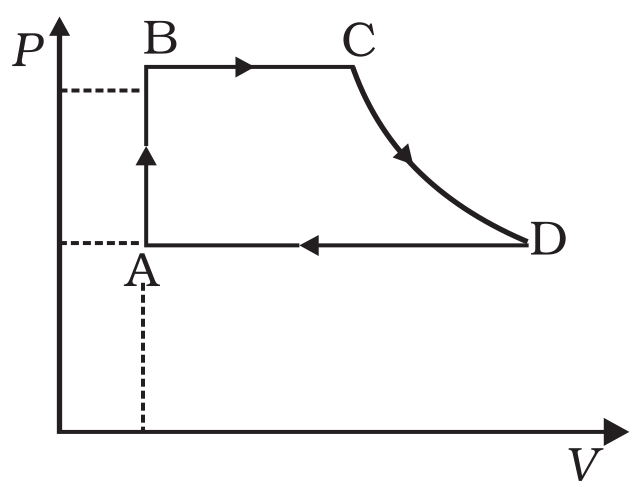
A cycle followed by an engine (made of one mole of an ideal gas in a cylinder with a piston) is shown in Fig. Find heat exchanged by the engine, with the surroundings for each section of the cycle. $(C_v = (3/2) R)$

AB : constant volume
BC : constant pressur CD : adiabati DA : constant pressure
The resistance of an iron wire and a copper wire at 20°C are $3.9\Omega$ and $4.1\Omega,$ respectively. At what temperature will the resistance be equal? Temperature coefficient of resistivity for iron is $5.0\times10^{-3}\text{K}^{-1}$ and for copper, it is $4.0\times10^{-3}\text{K}^{-1}.$ Neglect any thermal expansion.
When a proton is released from rest in a room, it starts with an initial acceleration $a_0$ towards west. When it is projected towards north with a speed $v_0$, it moves with an initial acceleration $3a_0$ towards west. Find the electric field and the maximum possible magnetic field in the room.
A solid aluminium sphere and a solid copper sphere of twice the radius are heated to the same temperature and are allowed to cool under identical surrounding temperatures. Assume that the emissivity of both the spheres is the same. Find the ratio of:
  1. The rate of heat loss from the aluminium sphere to the rate of heat loss from the copper sphere.
  2. The rate of fall of temperature of the aluminium sphere to the rate of fall of temperature of the copper sphere. The specific heat capacity of aluminium = $900Jkg^{-1^\circ}C^{-1}$ and that of copper= $390Jkg^{-1^\circ}C^{-1}$. The density of copper = $3.4$ times the density of aluminium.
Two mercury droplets of radii $0.1cm$. and $0.2cm$. collapse into one single drop. What amount of energy is released? The surface tension of mercury $T = 435.5 \times 10^{-3}N m^{-1}$
A sample of an ideal gas $(\gamma=1.5)$ is compressed adiabatically from a volume of $150cm^3$ to $50cm^3$. The initial pressure and the initial temperature are $150kPa$ and $300K$. Find,
  1. The number of moles of the gas in the sample.
  2. The molar heat capacity at constant volume.
  3. The final pressure and temperature.
  4. The work done by the gas in the process.
  5. The change in internal energy of the gas.
Prove that closed argon pipe produced only odd harmonics whereas both odd and even harmonic are produced in an open argon pipe.
A solid sphere of mass 0.50kg is kept on a horizontal surface. The coefficient of static friction between the surfaces in contact is $\frac{2}{7}.$ What maximum force can be applied at the highest point in the horizontal direction so that the sphere does not slip on the surface?
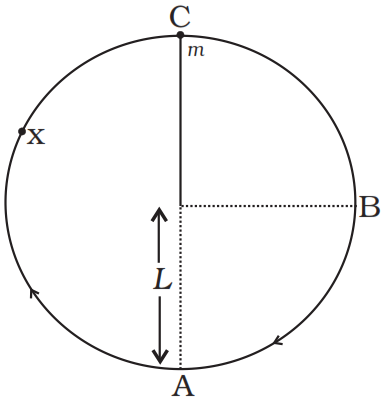
A bob of mass m suspended by a light string of length L is whirled into a vertical circle as shown in what will be the trajectory of the particle if the string is cut at:
  1. Point B?
  2. Point C?P
  3. oint X?