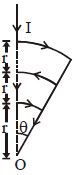
Shown in the figure is a conductor carrying a current $I$. The magnetic field intensity at the point $O$ (common centre of all the three arcs) is
Medium
Download our app for free and get started
since, magnetic field at the centre of an $arc$ is equal to
$\mathrm{B}=\frac{\mu_{0} \mathrm{I}}{4 \pi \mathrm{r}} \theta$
Net $B=\frac{\mu_{0} I}{4 \pi}\left[\frac{1}{r}-\frac{1}{2 r}+\frac{1}{3 r}\right] \theta=\frac{5 \mu_{0} I \theta}{24 \pi r}$

Download our appand get started for free
Experience the future of education. Simply download our apps or reach out to us for more information. Let's shape the future of learning together!No signup needed.*
Similar Questions
- 1In an experiment, set up $A$ consists of two parallel wires which carry currents in opposite directions as shown in the figure. $A$ second set up $B$ is identical to set up $A$, except that there is a metal plate between the wires. Let $F_A$ and $F_B$ be the magnitude of the force between the two wires in setup $A$ and setup $B$, respectively.View Solution
- 2View SolutionAssertion : Cyclotron does not accelerate electron.
Reason : Mass of the electrons is very small
- 3An electron is moving along $+x$ direction. To get it moving along an anticlockwise circular path in $x-y$ plane, magnetic field applied alongView Solution
- 4A square loop of side $2a$ and carrying current I is kept in $xz$ plane with its centre at origin. A long wire carrying the same current I is placed parallel to $z-$axis and passing through point $(0, b , 0),( b >> a ) .$ The magnitude of torque on the loop about $z-$ax is will beView Solution
- 5A circular current loop of radius a is placed in a radial field $B$ as shown. The net force acting on the loop isView Solution
- 6For a moving coil galvanometer, the deflection in the coil is $0.05\,rad$ when a current of $10\,mA$ is passed through it. If the torsional constant of suspension wire is $4.0 \times 10^{-5}\,Nm\,rad ^{-1}$, the magnetic field is $0.01\,T$ and the number of turns in the coil is $200$,the area of each turn (in $cm ^2$ ) is :View Solution
- 7A charge particle projected with velocity $\vec v$ in uniform magnetic field ' $\vec B$ ' then for maximum magnetic force on it, which is correctView Solution
- 8A circular coil of $500$ turns encloses an area of $0.04 \,m^2.$ A uniform magnetic field of induction $0.25\, Wb/m^2$ is applied perpendicular to the plane of the coil. The coil is rotated by $90^o$ in $0.1$ second at a constant angular velocity about one of its diameters. A galvanometer of resistance $25\Omega$ was connected in series with the the coil. The total charge that will pass through the galvanometer is.......$C$View Solution
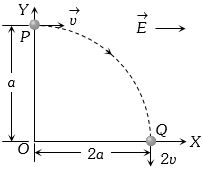
- 9A particle of charge $+q$ and mass $m$ moving under the influence of a uniform electric field $E\hat i$ and a uniform magnetic field $B\hat k$ follows trajectory from $P$ to $Q$ as shown in figure. The velocities at $P$ and $Q$ are $v\hat i$ and $ - 2v\hat j$ respectively. Which of the following statement(s) is/are correctView Solution
- 10A $100$ $turns$ coil shown in figure carries a current of $2\, amp$ in a magnetic field $B = 0.2\,Wb/{m^2}$. The torque acting on the coil isView Solution