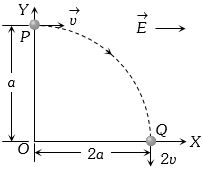
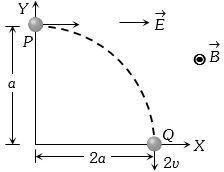
A particle of charge $+q$ and mass $m$ moving under the influence of a uniform electric field $E\hat i$ and a uniform magnetic field $B\hat k$ follows trajectory from $P$ to $Q$ as shown in figure. The velocities at $P$ and $Q$ are $v\hat i$ and $ - 2v\hat j$ respectively. Which of the following statement(s) is/are correct
IIT 1991, Diffcult


Download our appand get started for free
Experience the future of education. Simply download our apps or reach out to us for more information. Let's shape the future of learning together!No signup needed.*
Similar Questions
- 1A thin circular frame of radius $'a'$ is made of insulating material. A square loop is constructed with in it. If loop carrying current $I$ , then magnetic induction at geometrical centre $'O'$ will beView Solution

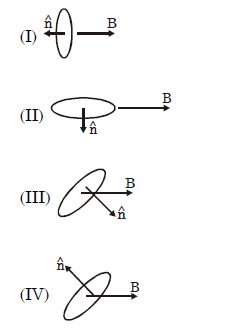
- 2A current carrying loop is placed in a uniform magnetic field in four different orientations; $I,\, II,\, III$ and $IV,$ arrange them in the decreasing order of potential energyView Solution
- 3A length $L$ of wire carries a steady current $I$. It is bent first to form a circular plane coil of one turn. The same length is now bent more sharply to give a double loop of smaller radius. The magnetic field at the centre caused by the same current isView Solution
- 4A long straight wire carrying current of $30\,A$ is placed in an external uniform magnetic field of induction $4 \times 10^{-4}$ $T$. The magnetic field is acting parallel to the direction of current. The magnitude of the resultant magnetic induction in tesla at a point $2.0\, cm$ away from the wire isView Solution
- 5A particle of mass $M$ and charge $Q$ moving with velocity $\mathop v\limits^ \to $ describes a circular path of radius $R$ when subjected to a uniform transverse magnetic field of induction $B$. The work done by the field when the particle completes one full circle isView Solution
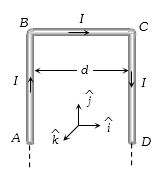
- 6An electron having charge $1.6 \times {10^{ - 19}}\,C$ and mass $9 \times {10^{ - 31}}\,kg$ is moving with $4 \times {10^6}\,m{s^{ - 1}}$ speed in a magnetic field $2 \times {10^{ - 1}}\,tesla$ in a circular orbit. The force acting on electron and the radius of the circular orbit will beView Solution
- 7A long solenoid has $n$ turns per meter and current $I\, A$ is flowing through it. The magnetic field at the ends of the solenoid isView Solution
- 8A straight conductor carries a current of $5A$. An electron travelling with a speed of $5 \times {10^6}\,m{s^{ - 1}}$ parallel to the wire at a distance of $0.1\,m$ from the conductor, experiences a force ofView Solution
- 9A horizontal rod of mass $10\, gm$ and length $10\, cm$ is placed on a smooth plane inclined at an angle of $60^\circ $ with the horizontal, with the length of the rod parallel to the edge of the inclined plane. A uniform magnetic field of induction $B$ is applied vertically downwards. If the current through the rod is $1.73$ $ampere$, then the value of $B$ for which the rod remains stationary on the inclined plane is......$Tesla$View Solution
- 10$AB$ and $CD$ are long straight conductor, distance $d$ apart, carrying a current $I$. The magnetic field at the midpoint of $BC$ isView Solution