Question
Simplify by rationalising the denominator:$\frac{7\sqrt{3}-5\sqrt{2}}{\sqrt{48}+\sqrt{18}}$

Answer

$\frac{7\sqrt{3}-5\sqrt{2}}{\sqrt{48}+\sqrt{18}}$$=\frac{7\sqrt{3}-5\sqrt{2}}{\sqrt{16\times3}+\sqrt{9\times2}}$
$=\frac{7\sqrt{3}-5\sqrt{2}}{4\sqrt{3}+3\sqrt{2}}$
$=\frac{7\sqrt{3}-5\sqrt{2}}{4\sqrt{3}+3\sqrt{2}}\times\frac{4\sqrt{3}-3\sqrt{2}}{4\sqrt{3}-3\sqrt{2}}$
$=\frac{7\sqrt{3}\times4\sqrt{3}-7\sqrt{3}\times3\sqrt{2}-5\sqrt{2}\times4\sqrt{3}+5\sqrt{2}\times3\sqrt{2}}{\big(4\sqrt{3}\big)^2-\big(3\sqrt{2}\big)^2}$
$=\frac{28\times3-21\sqrt{6}-20\sqrt{6}+15\times2}{16\times3-9\times2}$
$=\frac{84-41\sqrt{6}+30}{48-18}$
$=\frac{114-41\sqrt{6}}{30}$

Need a full question paper?

Generate a complete, print-ready paper with questions like this in minutes — across 16+ boards, with answer keys.

Start Generating Free

Similar questions

If a diameter of a circle bisects each of the two chords of a circle then prove that the chords are parallel.
P is a point on the bisector of $\angle\text{ABC}.$ If the line through P, parallel to BA meets BC at Q, prove that $\triangle\text{BPQ}$ is an isosceles triangle.
Explain the reading and interpretation of bar graphs.
In the following, using the remainder theorem, find the remainder when $f(x)$ is divided by $g(x)$ and verify the by actual division:
$f(x) = x^3 + 4x^2 - 3x + 10, g(x) = x + 4$
Find the missing value of p for the following distribution whose mean is 12.58.
x:
5
8
10
12
p
20
25
f:
2
5
8
22
7
4
2
Plot the following points on the graph paper:(0, 7)
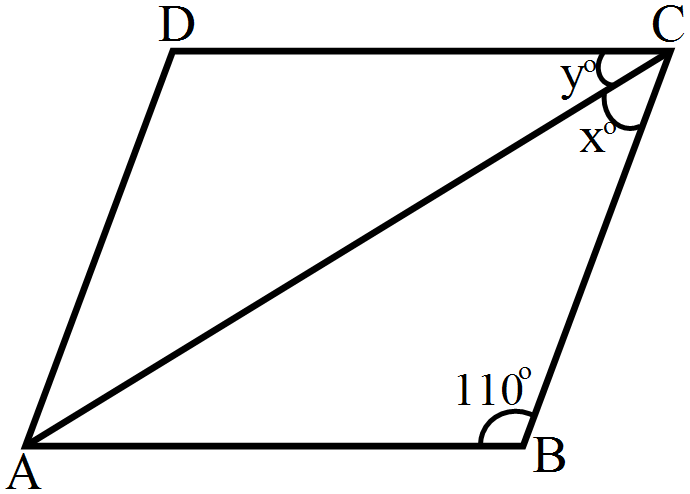
In each of the figures given below, ABCD is a rhombus. Find the value of x and y in each case.
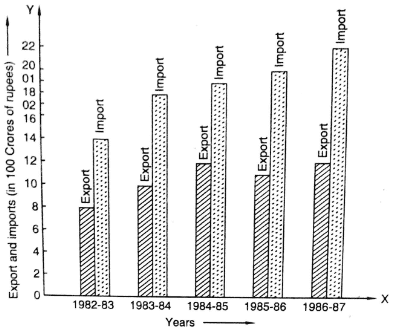
Read the following bar graph and answer the following questions:
  1. What information is given by the bar graph?
  2. In which year the export is minimum?
  3. In which year the import is maximum?
  4. In which year the difference of the values of export and import is maximum?
​​​​​​​
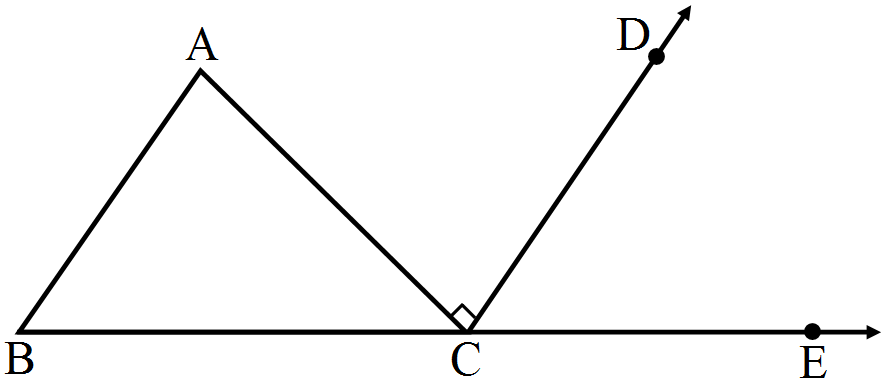
In a $\triangle\text{ABC},$ it is given that $\angle\text{A}:\angle\text{B}:\angle\text{C}=3:2:1$ and $\text{CD}\perp\text{AC}.$ Find $\angle\text{ECD}.$
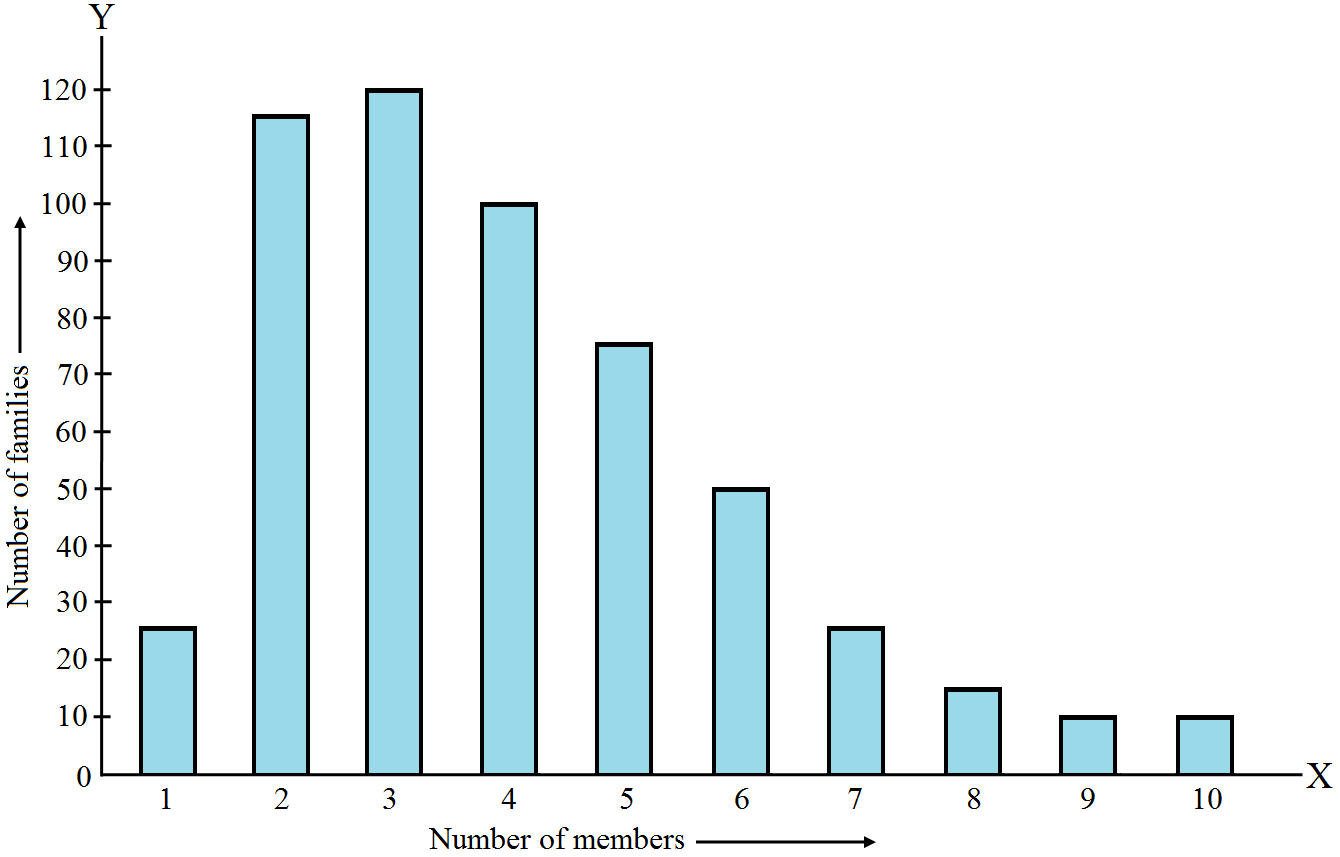
Read the bar graph given in figure and answer the following questions:
  1. What is the information given by the bar graph?
  2. What is the number of families having 6 members?
  3. How many members per family are there in the maximum number of families? Also tell the number of such families.
  4. What are the number of members per family for which the number of families are equal? Also, tell the number of such families?