The maximum static frictional force is
Easy


Download our appand get started for free
Experience the future of education. Simply download our apps or reach out to us for more information. Let's shape the future of learning together!No signup needed.*
Similar Questions
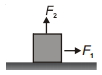
- 1In the figure shown, horizontal force $F_1$ is applied on a block but the block does not slide. Then as the magnitude of vertical force $F_2$ is increased from zero the block begins to slide; the correct statement isView Solution
- 2A brick of mass $2\, kg$ begins to slide down on a plane inclined at an angle of $45^° $ with the horizontal. The force of friction will beView Solution
- 3The maximum speed that can be achieved without skidding by a car on a circular unbanked road of radius $R$ and coefficient of static friction $\mu $, isView Solution
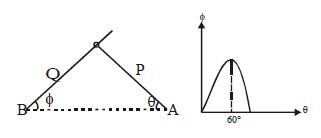
- 4A rod $P$ of length $1\ m$ is hinged at one end $A$ and there is a ring attached to the other end. Another long rod $Q$ is hinged at $B$ and it passes through the ring. The rod $P$ is rotated about an axis which is perpendicular to plane in which both the rods are present and the variation between the angles $\theta$ and $\phi $ are plotted as shown. The distance between the hinges $A$ and $B$ is ....... $m$.View Solution
- 5If the radius of curvature of the path of two particles of same masses are in the ratio $1 : 2$, then in order to have constant centripetal force, their velocity, should be in the ratio ofView Solution
- 6A mass of $100\, gm$ is tied to one end of a string $2 \,m$ long. The body is revolving in a horizontal circle making a maximum of $200$ revolutions per min. The other end of the string is fixed at the centre of the circle of revolution. The maximum tension that the string can bear is .......... $N$. (approximately)View Solution
- 7A body of mass $\mathrm{m}$ is kept on a rough horizontal surface (coefficient of friction $=\mu$ ) A horizontal force is applied on the body, but it does not move. The resultant of normal reaction and the frictional force acting on the object is given by $\mathrm{F},$ where $\mathrm{F}$ isView Solution
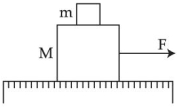
- 8A system of two blocks of masses $m =2 \; kg$ and $M=8 \; kg$ is placed on a smooth table as shown in figure. The coefficient of static friction between two blocks is $0.5$. The maximum horizontal force $F$ that can be applied to the block of mass $M$ so that the blocks move together will be $\dots \; N$View Solution
- 9A force $F = Kt$ (where $t$ is the time in seconds and $K = 2\, N/s$) is applied on $2 \,kg$ block at $t = 0$ as shown in the figure. The displacement of $8\ kg$ block till the time when $2\, kg$ block start slipping on $8\,kg$ block will be (coefficient of friction between $2\,kg$ block and $8\, kg$ block is $0.2$ and between $8\, kg$ block and surface is zero,View Solution
$g = 10m/s^2)$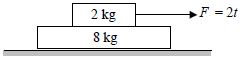
- 10A particle moves in a horizontal circle on the smooth inner surface of a hemispherical bowl of radius $R$. The plane of motion is at a depth $d$ below the centre of the hemisphere. The speed of the particle is :-View Solution