Question
State and explain Maxwell’s right-hand thumb rule.

Answer

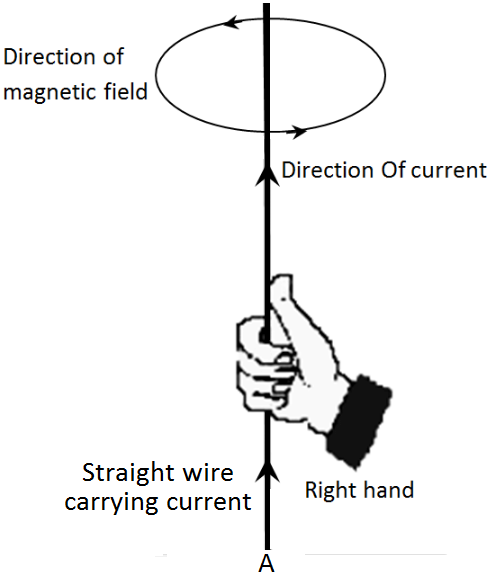
According to Maxwell’s right hand thumb rule: Imagine that you are grasping the currentcarrying wire in your right hand so that your thumb points in the direction of current, then the direction in which your fingers encircle the wire will give the direction of magnetic field lines around the wire.
Let AB be the straight wire carrying current in the vertically upward direction from A to B. To find out the direction of the magnetic field lines produced by this current, we imagine that we are grasping the current carrying wire in our right hand as shown in fig. so that our thumb points in the direction of current towards B. Now, the direction in which our fingers are folded gives the direction of magnetic field lines. In this case, the direction of magnetic field lines is in the anticlockwise direction.

Need a full question paper?

Generate a complete, print-ready paper with questions like this in minutes — across 16+ boards, with answer keys.
Start Generating Free

Similar questions

DNA copies generated will be similar, but may not be completely identical to the original.’ Explain the statement concerning asexually reproducing organisms.’
An element X of group 15 exists as diatomic molecule and combines with hydrogen at 773K in presence of the catalyst to form a compound, ammonia which has a characteristic pungent smell.
  1. Identify the element X. How many valence electrons does it have?
  2. Draw the electron dot structure of the diatomic molecule of X. What type of bond is formed in it?
  3. Draw the electron dot structure for ammonia and what type of bond is formed in it?
X and Y are two human beings. The organ A in the reproductive system of X releases a mature gamete B once a month which goes into a tube-like structure C through a funnel-like opening. The organ D in the reproductive system of Y makes and releases gametes E which pass through a duct F and are introduced by an organ of Y, into the body of X. B and E fuse together in C to form a new cell G. The cell G divides repeatedly to form a ball of cells H which gets embedded in the lining of organ I of reproductive system of X where it grows and develops into a baby.
  1. Name (i) organ A, and (ii) gamete B.
  2. Write two names of tube-like structure C.
  3. Name (i) organ D, and (ii) gamete E.
  4. Write two names of duct F.
  5. Name (i) cell G (ii) ball of cells H, and (iii) organ I.
  6. Out of X and Y, which one is (i) male, and (ii) female?
An industry is being established near a town. How can the wastes generated from this industry affect the local environment?
  1. List in tabular from three chemical properties on the basis of which we can differentiate between a metal and a non-metal.
  2. Give reasons for the following:
  1. Most metals conduct electricity well.
  2. The reaction of iron (III) oxide $\left[ Fe _2 O _3\right]$ with heated aluminium is used to join cracked machine parts.
Define pollination. Explain the different types of pollination. List two agents of pollination? How does suitable pollination lead to fertilization?
Explain the digestion of chapati in human beings. Draw a diagram depicting human alimentary canal.
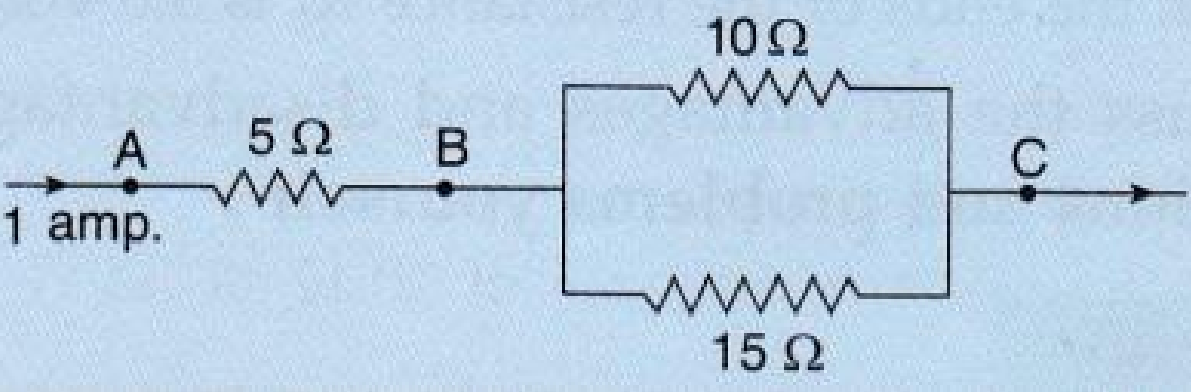
Three resistors are connected as shown in the diagram.

Through the resistor 5 ohm, a current of 1 ampere is flowing,
  1. What is the current through the other two resistors?
  2. What is the p.d. across AB and across AC?
  3. What is the total resistance?
Give the various functions of brain.
An object is placed at a distance of 30cm from a concave lens of focal length 15cm. List four characteristics (nature, position, etc.) of the image formed by the lens.