Question
State and explain the Clock face rule for determining the polarities of a circular wire carrying current.

Answer

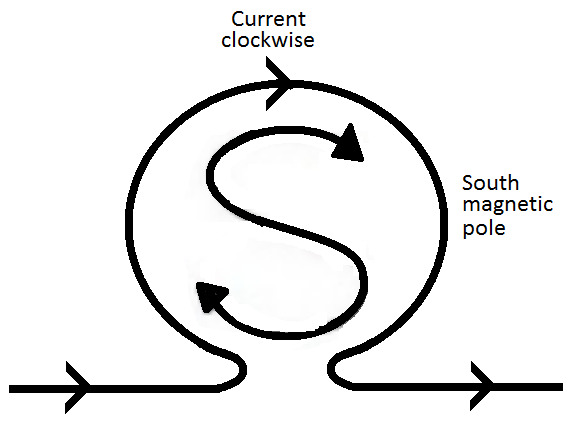
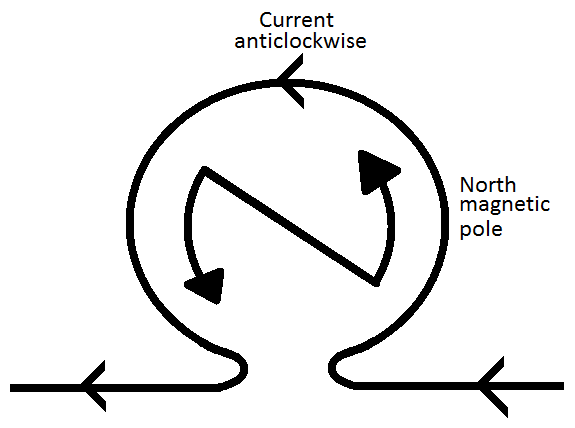
According to the Clock face rule, we look at one face of a circular wire (or coil) through which a current is passing:
  1. If the current around the face of the circular wire (or coil) flows in the clockwise direction, then that face of the circular wire will be South pole (S-pole)
  1. If the current around the face of the circular wire (or coil) flows in the anti-clockwise direction, then that face of the circular wire will be North pole (N-pole).

Need a full question paper?

Generate a complete, print-ready paper with questions like this in minutes — across 16+ boards, with answer keys.
Start Generating Free

Similar questions

Define nutrition. What are the different modes of nutrition?
What are the disadvantages of burning fossil fuels?
An object 3cm high is placed at a distance of 10cm in front of a converging mirror of focal length 20cm. Find the position, nature and size of the image formed.
$i.$ A wire of resistance $2$ has been connected to a source of $50 V$ as its two ends. What is the current flowing
through the wire?
$ii.$ An electric kettle rated at $220 V, 2.2 kW$ works for $3h.$ Calculate the energy consumed and the current drawn.
Describe the process of respiration in State whether it is anaerobic respiration or aerobic respiration.
How can ethanol and ethanoic acid be differentiated on the basis of their physical and chemical properties?
What is meant by ‘rusting’? With labelled diagrams describe an activity to find out the conditions under which iron rusts.
A current of 1 ampere flows in a series circuit containing an electric lamp and a conductor of 5Ω when connected to a 10V battery. Calculate the resistance of the electric lamp.
Now if a resistance of 10Ω is connected in parallel with this series combination, what change (if any) in current flowing through 5Ω conductor and potential difference across the lamp will take place? Give reason.
Identify the type of reaction: $\text{MnO}_2+4\text{HCl}\rightarrow\text{MnCl}_2+2\text{H}_2\text{O}+\text{Cl}_2$
The magnification of an image formed by a lens is –1. If the distance between the object and its image is 60cm, what is the distance of the object from the optical centre of the lens? Find the nature and focal length of the lens. If the object is displaced 20cm towards the optical centre of the lens, where would the image be formed and what would be its nature? Draw a ray diagram to justify your answer.