Question
State Bernoulli's theorem. Using it how can you explain the functioning of a venturimeter to find velocity of flow of liquid through a tube?
$\frac{\text{P}}{\rho}+\frac{\text{v}^2}{2}+\text{gh}=\text{constant}$
$\frac{\text{P}}{\rho\text{g}}+\frac{\text{v}^2}{2\text{g}}+\text{h}=\text{constant}$
A liquid is said to be irrotational if the angular momentum about any point in the liquid is zero. A wheel or disc in it will not rotate.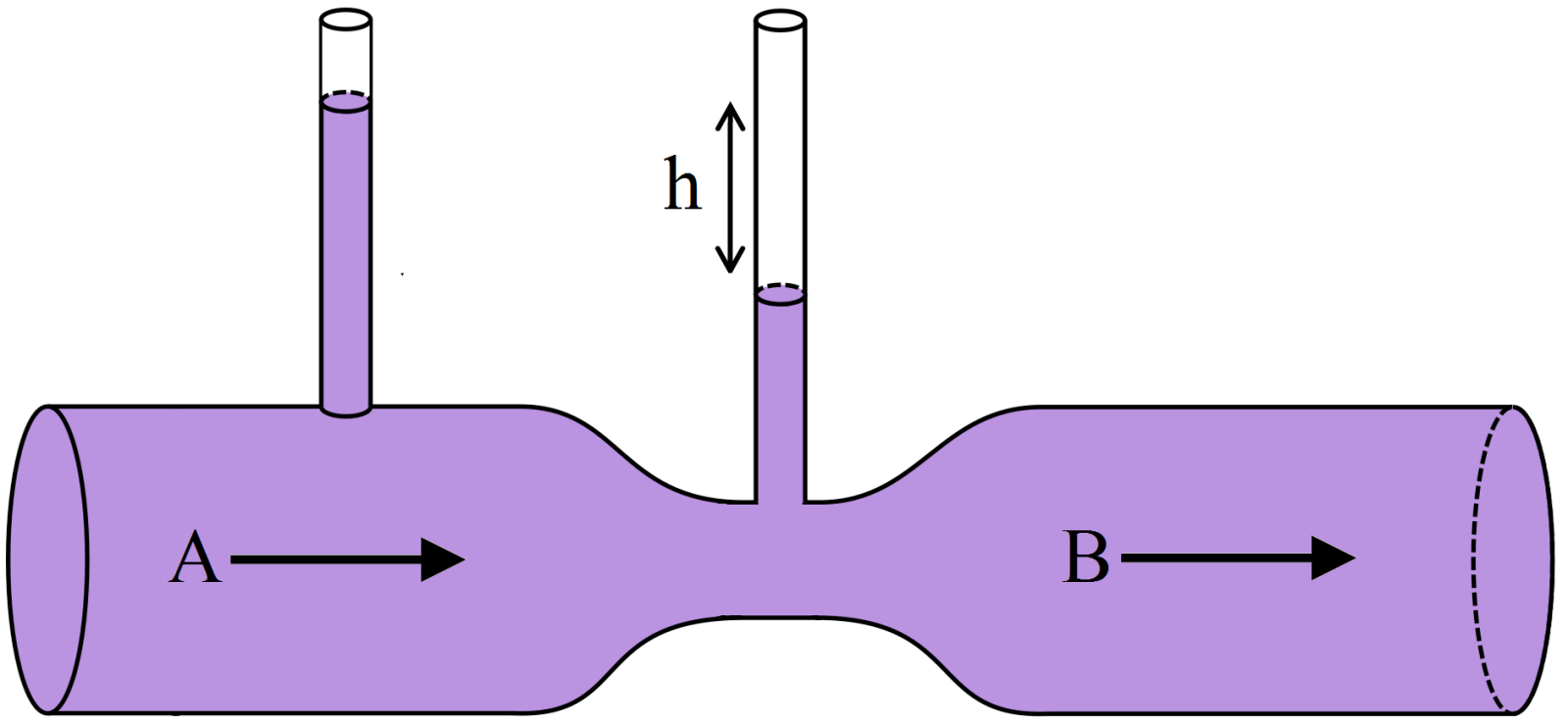 Given: $\text{a}_1=0.36\pi\text{cm}^2,\text{a}_2=0.04\pi\text{m}^2,\text{h}=1\text{m}.$ Since, c.s.a. at B is less velocity will be more and pressure will be less. The difference in pressure is $\text{P}_1-\text{P}_2=\text{h}\rho\text{g}.$ Applying Bernoulli's theorem,
 $\frac{\text{P}_1}{\rho\text{g}}+\frac{\text{v}^2_1}{\text{ 2}\text{g}}=\frac{\text{P}_2}{\rho\text{g}}+\frac{\text{v}^2_2}{\text{2g}}$
$\Rightarrow\frac{\text{P}_1-\text{P}_2}{\rho\text{g}}=\frac{\text{v}^2_2-\text{v}^2_1}{\text{2g}}$
$\therefore\text{v}^2_2-\text{v}^2_1=2\text{gh}$
$\because$ for streamlined flow, $\text{a}_1\text{v}_1=\text{a}_2\text{v}_2$
$\text{v}^2_2-\frac{\text{a}^2_2\text{v}^2_2}{\text{a}^2_1}=2\text{gh}$
$\Rightarrow\text{v}^2_2=2\text{gh}\begin{pmatrix}\frac{1}{1-\Bigg(\frac{\text{a}^2_2}{\text{a}^2_2}\Bigg)}\end{pmatrix}$
$\Rightarrow\text{v}_2=\sqrt{\frac{2\text{2gh}\text{a}^2_1}{\text{a}^2_1-\text{a}^2_2}}=5\text{m/s}$
Generate a complete, print-ready paper with questions like this in minutes — across 16+ boards, with answer keys.
| Element | Ne | P | Ca | Mn | Zn | Br |
| Energy (keV) | 0.858 | 2.14 | 4.02 | 6.51 | 9.57 | 13.3 |