Question
State differences between nuclear fusion and nuclear fission.

Answer

Get the step-by-step solution for this question inside the Vidyadip app.

Get the answer in the app

Need a full question paper?

Generate a complete, print-ready paper with questions like this in minutes — across 16+ boards, with answer keys.
Start Generating Free

Similar questions

(i) An electric bulb is rated $240 V-60 W$ and is working at $100 \%$ efficiency.
(a) Calculate the resistance of the bulb.
(b) If an identical bulb is connected in series with this bulb, then :
(i) Draw the circuit diagram.
(ii) What is the rate of conversion of energy in each bulb?
(iii) Total power used by the bulbs.
(ii) A family uses 2 light bulbs of 60 W , a fan of 120 W and a heater of 750 W an average of 8 hours a day. If the cost of electricity is ₹ 3.50 per unit, what is the daily expenditure of the family in a day?
(iii) A bulb is marked $150 W-220 V$ and an electric heater is marked $1500 W-220 V$.
(a) What is the ratio of resistance of these two devices?
(b) How does power rating of a device help you to select the type of connecting wire to be used?
(c) Which of the above devices needs thicker connecting wire?
Explain how you will determine the position of the centre of gravity experimentally for a triangular lamina (or a triangular piece of cardboard)
Prove that Moment of couple = Force x couple arm.
An illuminated object lies at a distance 1.0 m from a screen. A convex lens is used to form the image of object on a screen placed at distance 75 cm from the lens . Find: (i) the focal length of lens, and (ii) the magnification.
(i) Define machine and write functions of a machine.
(ii) Describe mechanical advantage and its types.
(iii) (a) Derive relation between the efficiency, mechanical advantage, and the velocity ratio of a practical machine.
(b) Derive relation between ideal mechanical advantage and velocity ratio for a perfect machine
How does a convex lens act as a ‘converging lens’?
How will you investigate the existence of the radiation beyond the red and violet extremes of the spectrum?
State Fleming's left hand rule.
A radar sends a signal to an aeroplane at a distance $45 \ km$ away with a speed of $3 \times 10^8 m s^{-1}$. After how much time is the signal received back from the aeroplane?
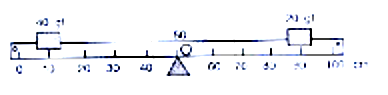
The figure shows a uniform metre rule placed on a function at its mid-point O and having a weight 40 gf at the 10 cm mark and a weight of 20 gf at the 9.0 cm mark.Is the metre rule in equilibrium?
If not how will the rule turn?