Question
State the principle of a transformer. Explain its construction and working. Derive an expression for the ratio of e.m.f.s in terms of number of turns in primary and secondary coil.
Answer

A transformer is a device with the help of which, a given alternating voltage can be increased or decreased to any desired value. The first type of transformer which delivers an output voltage smaller than the input voltage
is called a step down transformer. The second type of transformer which delivers an output voltage larger than the input voltage is called a step up transformer.
Principle of working of a transformer:
A transformer works on the principle that whenever the magnetic flux linked with a coil changes, an emf is induced in the neighbouring coil.Construction:
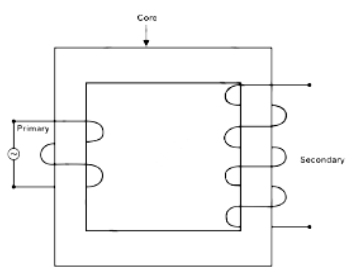
It consists of two coils, primary (P) and secondary (S), insulated from each other and wound on a soft iron core as shown in the figure below.
Image
The primary coil is called the input coil and the secondary coil is called the output coil.
Working:
When an alternating voltage is applied to the primary coil, the current through the coil goes on changing. Hence, the magnetic flux through the core also changes. As this changing magnetic flux is linked with both coils, an emf is induced in each of them. The amount of magnetic flux linked with the coil depends on the number of turns of the coil.Derivation:
Let $‘Φ’$ be the magnetic flux linked per turn with both coils at a certain instant of time $‘t’.$
Let the number of turns of the primary and secondary coils be $‘N_p’$ and $‘N_s’$, respectively.
Therefore, the total magnetic flux linked with the primary coil at certain instant of time $‘t’$ is $N_pΦ$. Similarly, the total magnetic flux linked with the secondary coil at certain instant of time $‘t’$ is $N_sΦ.$
Now, the induced emf in a coil is
\(e=\frac{d \phi}{d t}\)
Therefore, the induced emf in the primary coil is
\(e_p=\frac{d \phi_p}{d t}=\frac{d N_p \phi}{d t}=-N_p \frac{d \phi}{d t}\).......(1)
Similarly, the induced emf in the secondary coil is
\(e_s=\frac{d \phi_s}{d t}=\frac{d N_s \phi}{d t}=-N \frac{d \phi}{d t}\).......(2)
Dividing equations (1) and (2), we get
\(\frac{e_s}{e_p}=\frac{-N_s \frac{d \phi}{d t}}{-N_p \frac{d \phi}{d t}}=\frac{N_s}{N_p}\)........(3)
The above equation is called the equation of the transformer and the ratio \(\frac{N_s}{N_p}\) is known as the turns ratio of the transformer.
Now, for an ideal transformer, we know that the input power is equal to the output power.
\(\therefore P_p=P_s\)
\(\therefore e_p i_p=e_s i_s\)
\(\therefore \frac{e_s}{e_p}=\frac{i_p}{i_s}\)
From equation (3), we have
\(\frac{e_s}{e_p}=\frac{N_s}{N_P}\)
\(\therefore \frac{e_s}{e_p}=\frac{N_s}{N_p}=\frac{i_p}{i_s}\)

Need a full question paper?

Generate a complete, print-ready paper with questions like this in minutes — across 16+ boards, with answer keys.

Start Generating Free

Similar questions


Define mass flow rate or mass flux. Explain how it is related to the velocity of fluid.
Using Ampere’s law, obtain an expression for the magnetic induction near a current$-$carrying straight, infinitely long wire.
State an expression for the radius of gyration of
(i) a thin ring
(ii) a thin disc, about respective transverse symmetry axis.
OR
Show that for rotation about respective transverse symmetry axis, the radius of gyration of a thin disc is less than that of a thin ring.
Distinguish between centripetal force and centrifugal force. State any two points of distinction.
Derive an expression for capillary rise for a liquid having a concave meniscus.
The filament of an evacuated light bulb has length $10 \mathrm{~cm}$, diameter $0.2 \mathrm{~mm}$ and emissivity 0.2 . Calculate the power it radiates at $2000 \mathrm{~K} .\left(a=5.67 \times 10^{-8} \mathrm{~W} / \mathrm{m}^2 \cdot \mathrm{K}^4\right)$
A flywheel used to prepare earthenware pots is set into rotation at 100 rpm. It is in the form of a disc of mass 10 kg and
radius 0.4 m. A lump of clay (to be taken equivalent to a particle) of mass 1.6 kg falls on it and adheres to it at a certain
distance x from the centre. Calculate x if the wheel now rotates at 80 rpm.

State and explain the theorem of parallel axes.
Define
(1) the mean (or average) speed
(2) the mean square speed
(3) the root-mean-square speed of gas molecules. State the expressions for the same.
Determine the motional emf induced in a straight conductor moving in a uniform magnetic field with constant velocity.