- In a metre bridge [Fig. 3.27], the balance point is found to be at 39.5 cm from the end A, when the resistor Y is of $12.5\ \Omega.$ Determine the resistance of X. Why are the connections between resistors in a Wheatstone or meter bridge made of thick copper strips?
- Determine the balance point of the bridge above if X and Y are interchanged.
- What happens if the galvanometer and cell are interchanged at the balance point of the bridge? Would the galvanometer show any current?
Exercise
Download our app for free and get started
- Given,
Standard known resistance, $\text{S}=\text{Y}=12.5\ \Omega$
We have to determine the unknown resistance, R = X
Using the relation for balance condition we get,
$\text{S}=\frac{100-1}{1}\times\text{R}$
$\therefore\ \ 12.5=\frac{100-39.5}{39.5}\times\text{X}$
$\text{X}=\frac{12.5\times39.5}{60.5}=8.16\ \Omega$
Thick copper strips helps to minimise resistance of the connections and hence they are used.
- If, X and Y are interchanged,then, lengths are also interchanged.
- If the galvanometer and cell are interchanged, the position of the balance point remains unchanged. Hence, the galvanometer will show no current.

Download our appand get started for free
Experience the future of education. Simply download our apps or reach out to us for more information. Let's shape the future of learning together!No signup needed.*
Similar Questions
- 1View SolutionDefine the terms (i) drift velocity, (ii) relaxation time.
A conductor of length L is connected to a dc source of emf ε. If this conductor is replaced by another conductor of same material and same area of cross-section but of length 3L, how will the drift velocity change? - 2A plate of area $10\ cm^2$ is to be electroplated with copper $($density $9000\ kg/m^3)$ to a thickness of $10$ micrometres on both sides, using a cell of $12V$. Calculate the energy spent by the cell in the process of deposition. If this energy is used to heat $100g$ of water, calculate the rise in the temperature of the water. $\ce{ECE}$ of copper $= 3 \times 10^{-7}kg C^1 $ and specific heat capacity of water $= 4200Jkg^1.$View Solution
- 3The potential difference across a resistor $‘r\ ’$ carrying current $‘I\ ’$ is $Ir.$View Solution
- Now if the potential difference across $‘r\ ’$ is measured using a voltmeter of resistance $‘RV\ ’,$ show that the reading of voltmeter is less than the true value
- Find the percentage error in measuring the potential difference by a voltmeter.
- At what value of $RV,$ does the voltmeter measures the true potential difference?
- 4The potential difference between the terminals of a battery of emf 6.0V and internal resistance $1\Omega$ drops to 5.8V when connected across an external resistor. Find the resistance of the external resistor.View Solution
- 5View SolutionWhy are alloys used for making standard resistance coils?
- 6A storage battery of emf $8.0 V$ and internal resistance $0.5\ \Omega$ is being charged by a $120 V\ dc$ supply using a series resistor of $15.5\ \Omega.$ What is the terminal voltage of the battery during charging? What is the purpose of having a series resistor in the charging circuit?View Solution
- 7View SolutionHow many time constants will elapse before the current in a charging RC circuit drops to half of its initial value? Answer the same question for a discharging RC circuit.
- 8View SolutionA potentiometer wire of length 1 m is connected to a driver cell of emf 3 V as shown in the figure. When a cell of 1.5 V emf is used in the secondary circuit, the balance point is found to be 60 cm. On replacing this cell and using a cell of unknown emf, the balance point shifts to 80 cm.
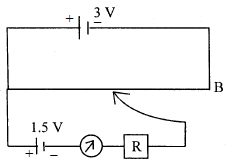
- Calculate unknown emf of the cell.
- Explain with reason, whether the circuit works, if the driver cell is replaced with a cell of emf 1 V.
- Does the high resistance R, used in the secondary circuit affect the balance point? Justify your answer.
- 9A coil of resistance $100\Omega$ is connected across a battery of emf $6.0V.$ Assume that the heat developed in the coil is used to raise its temperature. If the heat capacity of the coil is $4.0J/K,$ how long will it take to raise the temperature of the coil by $15^\circ C$?View Solution
- 10View SolutionA (i) series (ii) parallel combination of two given resistors is connected, one by one, across a cell. In which case will the terminal potential difference, across the cell have a higher value?