Question
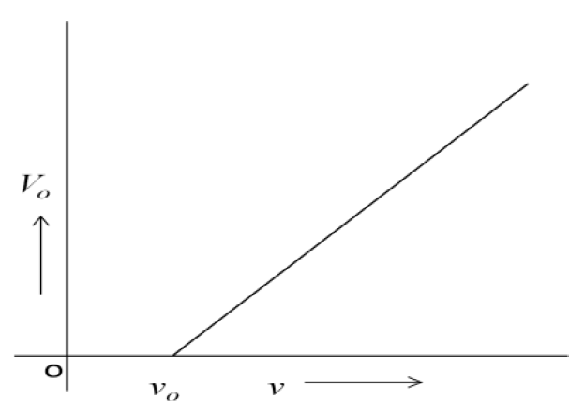
State two important properties of photon which are used to write Einstein's photoelectric equation. Define (i) Stopping potential and (ii) Threshold frequency, using Einstein's equation and drawing necessary plot between relevant quantities.

Answer

Properties of Photon:

  1. For a radiation of frequency$\upsilon$, each photon has an energy, $\text{E} = \text{h}v,$ associated with it.
  2. The energy of a photon is independent of the intensity of incident radiation.
  3. During the collision of a photon, with an electron, the total energy of the photon gets absorbed by the electron.

Einstein’s photoelectric equation is,

$\text{K}_{max} = \text{hv} - \phi_{0}$

or $\text{eV}_{0} = \text{hv} -\phi_{0}$

  1. Stopping potential, $\text{V}_{0}$ equals that value of the negative potential for which

$|\text{eV}_{0}| =\text{K}_{max}$

Alternate Answer

(The stopping potential ($\text{V}_{0}$) equals that (least) value of the (negative) plate potential that just stops the most energetic emitted photoelectrons from reaching the plate.)

  1. Threshold frequency $(\vartheta_{o})$ equals that value of the frequency of incident radiation for which $\text{K}_{max} = 0 . $

Alternate Answer

(For a given photosensitive surface, its threshold frequency is the minimum value of the frequency of incident radiation for which photoelectrons can be just emitted from that surface or that maximum frequency of incident radiation below which no photo emission takes place.)

The plot, between $\text{V}_{0}$ and$\vartheta , $ , has the form shown:
Need a full question paper?

Generate a complete, print-ready paper with questions like this in minutes — across 16+ boards, with answer keys.

Start Generating Free

Similar questions

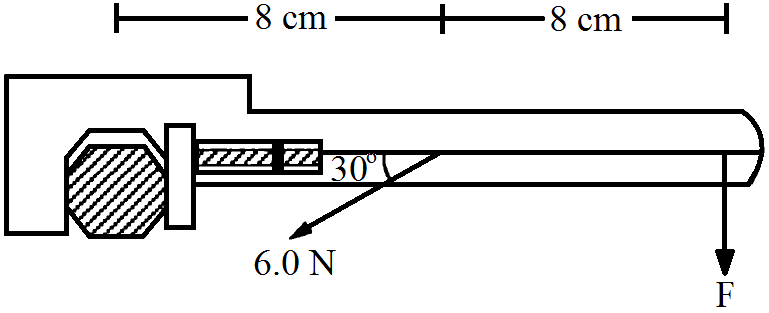
When a force of 6.0N is exerted at 30° to a wrench at a distance of 8cm from the nut, it is just able to loosen the nut. What force F would be sufficient to loosen it if it acts perpendicularly to the wrench at 16cm from the nut?

Two coherent waves of equal amplitude produce interference pattern in Young’s double slit experiment. What is the ratio of intensity at a point where phase difference is $\frac{\pi}{2}$ to intensity at centre?
An amount Q of heat is added to a monatomic ideal gas in a process in which the gas performs a work $\frac{\text{Q}}{2}$ on its surrounding. Find the molar heat capacity for the process.
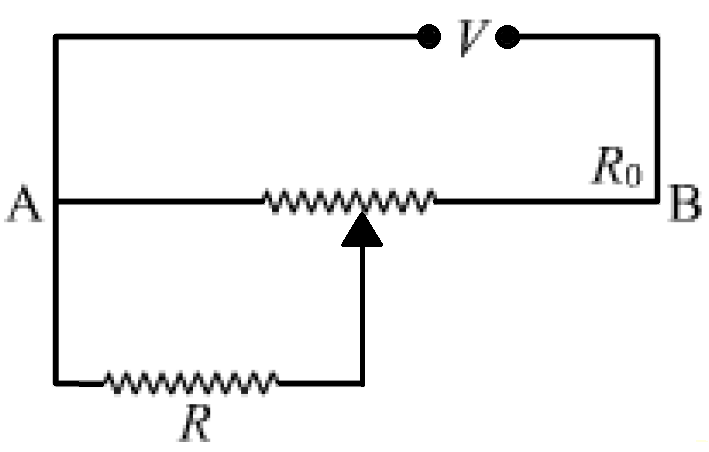
A resistance of R draws current from a potentiometer. The potentiometer wire, AB, has a total resistance of Ro. A voltage V is supplied to the potentiometer. Derive an expression for the voltage across R when the sliding contact is in the middle of potentiometer wire.

  1. Define the term ‘intensity of radiation’ in terms of photon picture of light.
  2. Two monochromatic beams, one red and the other blue, have the same intensity. In which case (i) The number of photons per unit area per second is larger, (ii) The maximum kinetic energy of the photoelectrons is more? Justify your answer.
Write a short note on $n$-type semi-conductors.
A monochromatic light source of intensity 6mW emits 8 × 10¹⁶ photons per second. This light ejects photoelectrons from a metal surface. The stopping potential for this setup is 2.0V. Calculate the work function of the metal.
Define the term ‘mutual inductance’ between the two coils.
Obtain the expression for mutual inductance of a pair of long coaxial solenoids each of length l and radii r1 and r2 (r2 >> r1). Total number of turns in the two solenoids are N1 and N2 respectively.
A metallic rod of length l is rotated at a constant angular speed $\omega , $  normal to a uniform magnetic field B. Derive an expression for the current induced in the rod, if the resistance of the rod is R.
Define the current sensitivity of a galvanometer. Write its S.I. unit.
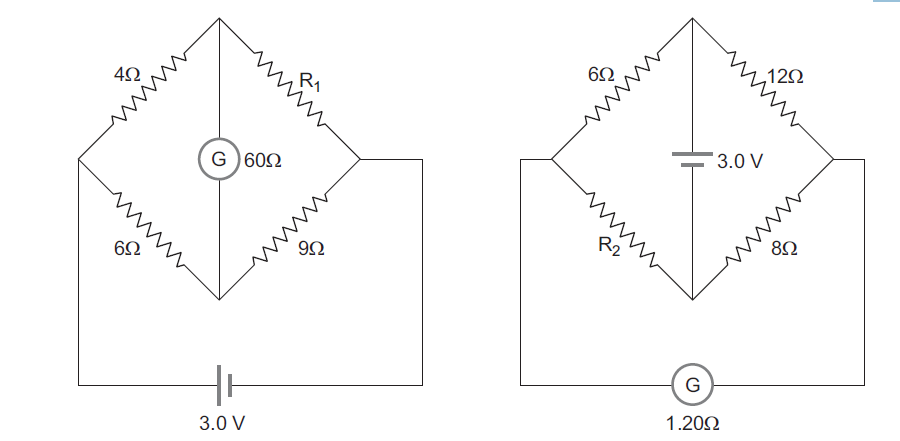
Figure shows two circuits each having a galvanometer and a battery of 3 V. When the galvanometers in each arrangement do not show any deflection, obtain the ratio R/ R2.