Question
State with equations what happens when borax is heated on a platinum wire loop and the resulting transparent mass is heated with CoO in Bunsen burner.
Answer

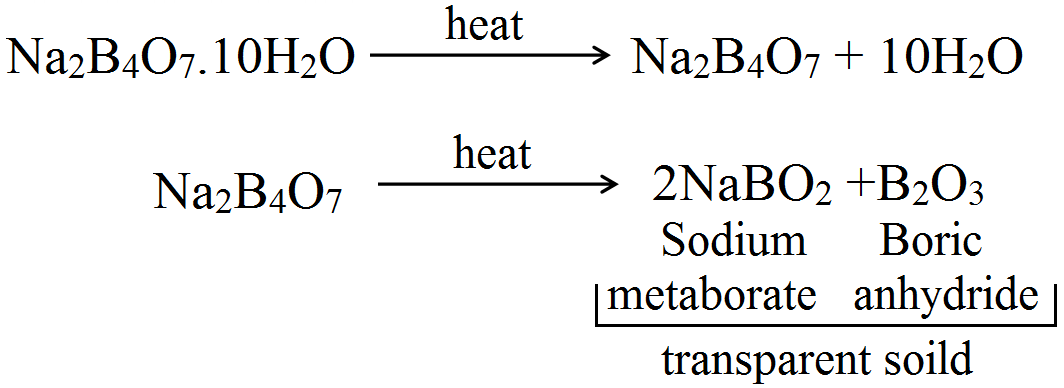
On heating borax on a platinum loop, borax first loses its water of crystallisation and swells upto form a puffy mass. On heating further, it melts to a transparent liquid which solidifies to a transparent mass.

This transparent solid is called borax bead. Whenever a coloured salt of $Co^{2+}, Cu^{2+}, Ni^{2+}$ etc. is heated with borax bead, the salt decomposes to form the corresponding metal oxide which combines with $B_2O_3$ present in the bead to form coloured metaborates e.g.,
$\text{CoO}\ \ +\ \ \text{B}_2\text{O}_3\ \xrightarrow{\ \ \ \text{heat}\ \ \ }\ \text{Co(BO}_2)_2\\ ^\text{Cobalt oxide} \ \ \ \ \ \ \ \ \ \ \ \ \ \ \ \ \ \ \ \ \ ^\text{Cobalt metaborate (blue)}$

Need a full question paper?

Generate a complete, print-ready paper with questions like this in minutes — across 16+ boards, with answer keys.

Start Generating Free

Similar questions

Calculate the atomic mass (average) of chlorine using the following data:
 
% Natural Abundance
Molar Mass
${ }^{35} \mathrm{Cl}$
75.77
34.9689
${ }^{35} \mathrm{Cl}$
24.23
36.9659
  1. Why air is dense at the sea level? Explain.
  2. Calculate the total pressure in a mixture of 4 g of $\mathrm{O}_2$ and 2 g of $\mathrm{H}_2$ confined to a total volume of 1 L at $0^{\circ} \mathrm{C} .(\mathrm{R}=$ $\left.0.0821 \mathrm{~L} \mathrm{~atm} \mathrm{~mol}^{-1}\right)$.
How much water is produced from complete combustion of 30 gm propyne.
If two elements can combine to form more than one compound, the masses of one element that combine with a fixed mass of the other element, are in whole number ratio.
  1. Is this statement true?
  2. If yes, according to which law?
  3. Give one example related to this law.
Calculate the molar solubility of $Ni ( OH )_2$ in 0.10 M NaOH . The ionic product of $Ni ( OH )_2$ is $2.0 \times 10^{-15}$.
A compound on analysis was found to contain C = 34.6%, H = 3.85%, and 0 = 61.55%. Calculate its empirical formula.
How would you explain the fact that the first ionization enthalpy of sodium is lower than that of magnesium but its second ionization enthalpy is higher than that of magnesium?
What is the relationship between the members of following pairs of structures? Are they structural or geometrical isomers or resonance contributors?
The diameter of zinc atom is 2.6 $\mathring{\text{A}}$.Calculate,
  1. Radius of zinc atom in pm
  2. Number of atoms present in a length of 1.6cm if the zinc atoms are arranged side by side lengthwise.
Elements X, Y and Z have 4, 5 and 7 valence electrons respectively:
  1. Write the molecular formula of the compounds formed by these elements individually with hydrogen.
  2. Which of there compound will have the highest dipole moment?