Question
How much water is produced from complete combustion of 30 gm propyne.

Answer

$C _3 H _4+4 O _2 \longrightarrow 3 CO _2+2 H _2 O$
$(40 gm) \quad(2 \times 18 gm)$
According to balanced equation $H _2 O$ obtained from 1 mole $(40 gm )$ propyne $=2 \times 18= gm$
Water obtained from combustion of 30 gm propyne
$\begin{array}{l}
=\frac{2 \times 18 \times 30}{40} \\
=27 gm
\end{array}$

Need a full question paper?

Generate a complete, print-ready paper with questions like this in minutes — across 16+ boards, with answer keys.
Start Generating Free

Similar questions

Calculate the pressure exerted by 1.00 mol of $\mathrm{CO}_2(\mathrm{~g})$ at 298 K that occupies 65.4 mL using van der Waals' equation. 'a' for $\mathrm{CO}_2$ is $3.592 \mathrm{~L}^2 \mathrm{bar} / \mathrm{mol}^2$,
$\text { 'b' = 0.0427 } \mathrm{L} \mathrm{~mol}^{-1} .$
Compare it with the pressure predicted by ideal gas equation for the same conditions of T and P ?
$\mathrm{BeF}_2$ molecule is linear while $\mathrm{SF}_2$ is angular through both are triatomic?
100 mL of a liquid is contained in an insulated container at a pressure of 1 bar. The pressure is steeply increased to 100 bar. The volume of the liquid is decreased by 1 mL at this constant pressure. Find $\Delta H$ and $\Delta U$.
Account for the following:
i. Which is smaller $\mathrm{Fe}^{2+}$ or $\mathrm{Fe}^{3+}$, why?
ii. Chlorine (Cl) have more negative electron gain enthalpy than Fluorine (F).
[Atomic no.: $\mathrm{F}=9, \mathrm{Cl}=17]$
iii. Anions are bigger in size than their parent atom.
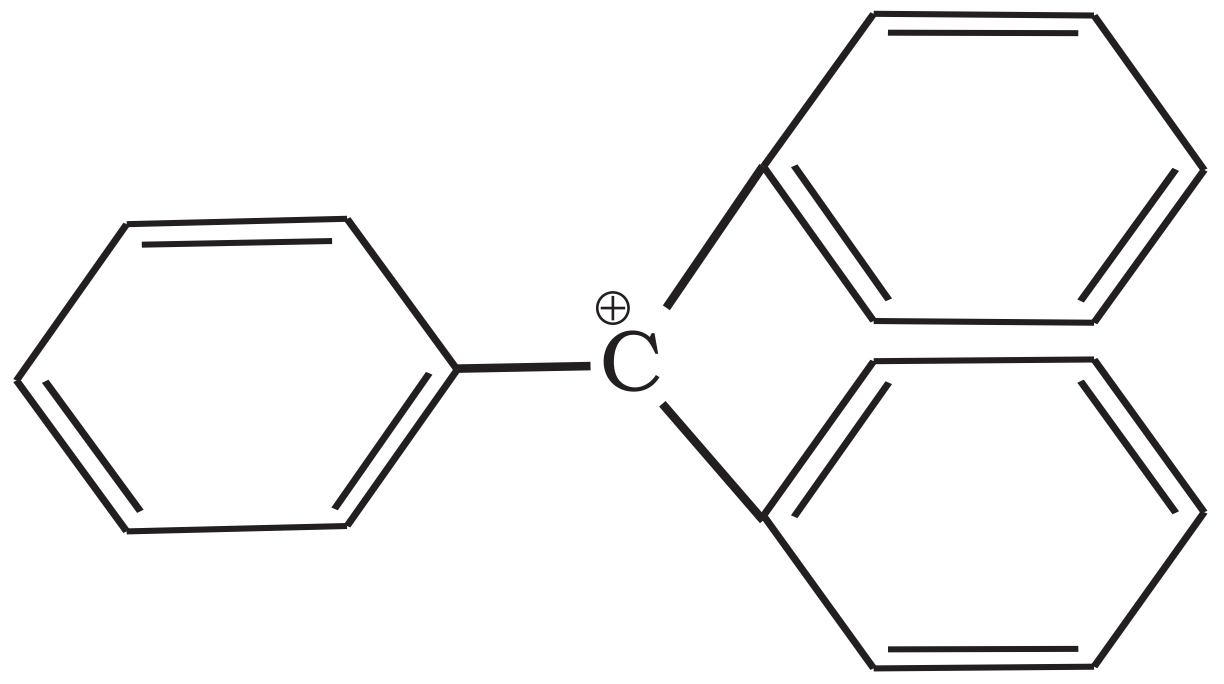
“Stability of carbocations depends upon the electron releasing inductive effect of groups adjacent to positively charged carbon atom involvement of neighbouring groups in hyperconjugation and resonance.”
The structure of triphenylmethyl cation is given below. This is very stable and some of its salts can be stored for months. Explain the cause of high stability of this cation.
What do you understand by the term ’auto-protolysis’ of water? What is its significance?
  1. Define principal quantum number(n).
  2. Write the electronic configuration of $Cr^+$ [Atomic number of Cr = 24].
  3. Define Pauli's exclusion principle.
A farmer was using pesticides on his farm. He used the produce of his farm as food for rearing fishes. He was told that fishes were not fit for human consumption because large amount of pesticides had accumulated in the tissues of fishes. Explain how did this happen?
Using the data (all values are in kilocalories per mole at $25^{\circ} C$ ) given below, calculate the bond energy of $C - C$ and C -
H bonds. $\Delta H ^{\circ}$ combustion (ethane) $=-372.0$
$\Delta H ^{\circ}$ combustion (propane) $=-530.0 \Delta H ^{\circ}$ for $C ($ graphite $) \rightarrow C ( g )=172.0$ Bond energy of $H - H =104.0 \Delta_{ f } H ^{\circ}$ of $H _2 O ( l )=-68.0 \Delta H ^{\circ}$ for $CO _2(g)=-94.0$
Give the number of electrons in the species $\text{H}^+_2,\text{H}_2$ and $\text{O}^+_2$