Question
State your observation for the following electrolytic reaction
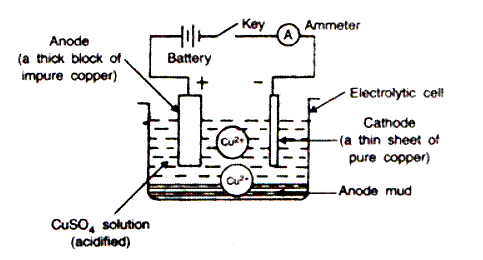
Aqueous copper sulphate is electrolysed between copper electrodes.
Answer

When Aqueous copper sulphate is electrolysed between copper electrodes then the ions formed are
$\ce{CuSO4 ⇌ Cu^{+2} + SO^{-2}_{4}}$
$\ce{H2O ⇌ H+ + OH-}$
Reaction at the Cathode : Copper and hydrogen ions both being positively charged migrate towards the cathode, Copper ions are discharged in preference to hydrogen ions, Copper gains two electrons from the cathode and changes into an atom of copper, The atoms of copper are deposited at the cathode, The atoms of copper are deposited at the cathode ad form a layer of pink copper metal which gradually turns reddish brown.
$\ce{Cu^{+2} + 2e- -> Cu}$
Reaction at the anode : Anode receives electrons from the ions and supplies them to the cathode, The atoms of copper from the anode changes into ions of copper which go into the solution and the electrons liberated in this change are taken up by the anode.
$\ce{Cu - 2e- -> Cu^{+2}}$
Thus for every copper ion discharged at the cathode, an ion of copper is formed at the anode which goes into the solution, Thus the atoms of copper are deposited at the cathode, the cathode becomes thicker and the atoms of
copper from the anode change into ions of copper, the anode becomes thinner.

Therefore there is transference of copper atoms from anode to cathode.

Need a full question paper?

Generate a complete, print-ready paper with questions like this in minutes — across 16+ boards, with answer keys.

Start Generating Free

Similar questions

State the factors that influence the preferential discharge of ions at the electrodes.
(a) Copy and complete the following table which refers to two practical applications of electrolysis
  Anode Electrolyte Cathode
Silver plating of a spoon   A solution of potassium argentocyanide  
Purification of copper      
(iii) Extraction of sodium      
(b) Write the equation taking place at the anode for Q. 2(a).
A gaseous hydrocarbon contains $82.76\%$ of carbon. Given that its vapour density is $29,$ find its molecular formula.
$[C = 12, H = 1]$
The gases hydrogen, oxygen, carbon dioxide, sulphur dioxide and chlorine are arranged in order of their increasing relative molecular mass. Given $8 g$ of each gas at $\text{STP},$ which gas will contain the least number of molecules and which gas the most?
State your observations when ammonium hydroxide solution is added drop by drop and then in excess to each of the following solutions :
1) Copper sulphate solution
2) Zinc sulfate solution.
Mr Ramu wants electrolyte his key chain with nickel to prevent rusting. For this electroplating
(i) Name the electrolyte
(ii) Name the cathode
(iii) Name the anode
(iv) Give the reaction at the cathode
(v) Give the reaction at the anode
How will you distinguish between dilute $H_2SO_4$ and conc. $H_2SO_4 ?$
During electrolysis of an aqueous solution of sulphuric acid between platinum electrodes, two types of anions migrate towards the anode but only one of themis discharged:
(a) Name the two anions,
(b) Name the main product of the discharge of anion at the anode and write the anode reaction,
(c) Name the product at the cathode and write the reaction.
(d) How you notice any change in colour. State why?
(e) Why this electrolysis, is considered as an example of catalysis?
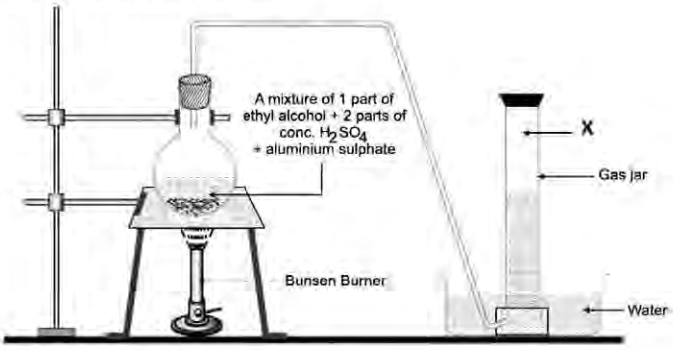
Look at the set-up of given apparatus carefully.
Image
(i) Identify 'X'.
(ii) Name the process of collection of 'X'. Justify.
(iii) Write the chemical equations involved.
(iv) What is the role of sulphuric acid in the above process?
(a) What are products obtained when methane reacts with chlorine in diffused sunlight?
(b) Write the equation when methane reacts with chlorine in diffused sunlight.
(c) Name and define the type of above reaction.