Statement $-1$ : Path of the charge particle may be straight line in uniform magnetic field.
Statement $-2$ : Path of the charge particle is decided by the angle between its velocity and the magnetic force working on it
Statement $-2$ : Path of the charge particle is decided by the angle between its velocity and the magnetic force working on it
Medium


Download our appand get started for free
Experience the future of education. Simply download our apps or reach out to us for more information. Let's shape the future of learning together!No signup needed.*
Similar Questions
- 1If a particle of charge ${10^{ - 12}}\,coulomb$ moving along the $\hat x - $ direction with a velocity ${10^5}\,m/s$ experiences a force of ${10^{ - 10}}\,newton$ in $\hat y - $ direction due to magnetic field, then the minimum magnetic field isView Solution
- 2A teacher in his physics laboratory allotted an experiment to determine the resistance $(G)$ of a galvanometer. Students took the observations for $\frac{1}{3}$ deflection in the galvanometer. Which of the below is true for measuring value of $G$ $?$View Solution
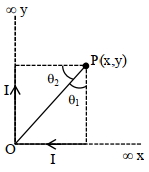
- 3There are two infinitely long straight current carrying conductors and they are held at right angles to each other so that their common ends meet at the origin as shown in the figure given below. The ratio of current in both conductor is $1: 1$. The magnetic field at point $P$ is ...... .View Solution
- 4The current in the windings on a toroid is $2.0\,A$. There are $400$ $turns$ and the mean circumferential length is $40\,cm$. If the inside magnetic field is $1.0\,T$, the relative permeability is near toView Solution
- 5A particle moving with velocity v having specific charge $(q/m)$ enters a region of magnetic field $B$ having width $d=\frac{{3mv}}{{5qB}}$ at angle $53^o$ to the boundary of magnetic field. Find the angle $\theta$ in the diagram......$^o$View Solution

- 6A milli voltmeter of $25\,millivolt$ range is to be converted in to an ammeter of $25\,A$ range. The value (in $ohm$) of necessary shunt will beView Solution
- 7The maximum current that can be measured by a galvanometer of resistance $40 \,\Omega$ is $10\, mA$. It is converted into a voltmeter that can read upto $50\, V$. The resistance to be connected in series with the galvanometer is ... (in $ohm$)View Solution
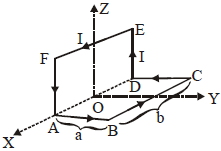
- 8A wire carrying current $I$ is bent in the shape $A\,B\,C\,D\,E\,F\,A$ as shown, where rectangle $A\,B\,C\,D\,A$ and $A\,D\,E\,F\,A$ are perpendicular to each other. If the sides of the rectangles are of lengths $a$ and $b,$ then the magnitude and direction of magnetic moment of the loop $A\,B\,C\,D\,E\,F\,A\,$ isView Solution
- 9A $2 \mathrm{~A}$ current carrying straight metal wire of resistance $1 \Omega$, resistivity $2 \times 10^{-6} \Omega \mathrm{m}$, area of cross-section $10 \mathrm{~mm}^2$ and mass $500 \mathrm{~g}$ is suspended horizontally in mid air by applying a uniform magnetic field $\vec{B}$. The magnitude of $B$ is__________.$\times 10^{-1} \mathrm{~T}\left(\right.$ given, $\mathrm{g}=10 \mathrm{~m} / \mathrm{s}^2$ )View Solution
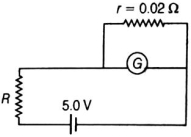
- 10In the circuit, shown the galvanometer $G$ of resistance $60\, \Omega$ is shunted by a resistance $r=0.02\, \Omega$. The current through $R$ (in $ohm$) is nearly $1\, A$. The value of resistance $R$ (in $ohm$) is nearly (in $\Omega$)View Solution