MCQ
Stokes' law states that the viscous drag force $F$ experienced by a sphere of radius $a$, moving with a speed $v$ through a fluid with coefficient of viscosity $\eta$, is given by $F=6 \pi \eta a v$.If this fluid is flowing through a cylindrical pipe of radius $r$, length $l$ and a pressure difference of $p$ across its two ends, then the volume of water $V$ which flows through the pipe in time $t$ can be written as

$\frac{v}{t}=k\left(\frac{p}{l}\right)^a \eta^b r^c$

where, $k$ is a dimensionless constant. Correct value of $a, b$ and $c$ are

  • $a=1, b=-1, c=4$
  • B
    $a=-1, b=1, c=4$
  • C
    $a=2, b=-1, c=3$
  • D
    $a=1, b=-2, c=-4$

Answer

Correct option: A.
$a=1, b=-1, c=4$
a
(a) By Stokes' law,

$F=6 \pi \eta a v$

We have, $\quad \eta=\frac{F}{6 \pi a v}$

Dimensions of viscosity index $\eta$ are

$\Rightarrow \quad[\eta]=\left[\frac{ MLT ^{-2}}{ L \cdot LT ^{-1}}\right]=\left[ ML ^{-1} T ^{-1}\right]$

Now, given relation of volume flow rate is

$\frac{V}{t}=k\left(\frac{p}{l}\right)^a \cdot \eta^b \cdot r^c$

Substituting dimensions of physical quantities and equating dimensions on both sides of equation, we have

$\frac{\left[ L ^3\right]}{[ T ]} =\left[ ML ^{-2} T ^{-2}\right]^a \cdot\left[ ML ^{-1} T ^{-1}\right]^b \cdot[ L ]^c$

$\Rightarrow\left[ M ^0 L ^3 T ^{-1}\right] =\left[ M ^{a+b} L ^{-2 a-b+c} T ^{-2 a-b}\right]$

$a+b=0 \quad \dots(i)$

$-2 a-b+c=3 \quad \dots(ii)$

$-2 a-b=-1 \quad \dots(iii)$

From Eqs. $(ii)$ and $(iii)$, we have

$c=4$

From Eqs. $(i)$ and $(iii)$, we have

$b=-1$

Substituting bin Eq. $(i)$, we have

$a=1$

So, $a=1, b=-1$ and $c=4$

Need a full question paper?

Generate a complete, print-ready paper with questions like this in minutes — across 16+ boards, with answer keys.

Start Generating Free

Similar questions

In a diatomic molecules, the rotational energy at a given temperature:
The physical quantity that has no dimensions
In the phenomenon of work done by variable forces, the forces:
A rigid body rotates about a fixed axis with variable angular velocity equal to $\alpha -\beta t$, where $t$ is time and $\alpha \,,\, \beta $ are constants. The angle (in radian) through which it rotates before its stops
If the mass of earth is $80$ times of that of a planet and diameter is double that of planet and $‘g’$ on earth is $9.8\,m/{s^2}$, then the value of $‘g’ $ on that planet is ........ $m/{s^2}$
A light pointer fixed to one prong of a tuning fork touches a vertical plate. The fork is set vibrating and the plate is allowed to fall freely. If eight oscillations are counted when the plate falls through $10 cm$, the frequency of the tuning fork is .... $Hz$
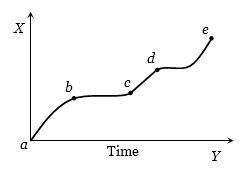
The displacement versus time graph for a body moving in a straight line is shown in figure. Which of the following regions represents the motion when no force is acting on the body
Distance between sun and Earth is $2 \times 10^{8}\, km ,$ temperature of sun $6000\, K ,$ radius of sun $7 \times 10^{5}\, km .$ If emmisivity of the earth is $0.6,$ find out the temperature of the earth in thermal equilibrium (in $k$)
A tuning fork resonates with a sonometer wire of length $1 \mathrm{~m}$ stretched with a tension of $6 \mathrm{~N}$. When the tension in the wire is changed to $54 \mathrm{~N}$, the same tuning fork produces $12$ beats per second with it. The frequency of the tuning fork is $\mathrm{Hz}$.
A black body at a temperature of  $1640\,\,K$  has the wavelength corresponding to maximum emission equal to $1.75 \,\,\mu m.$ Assuming the moon to be a perfectly black body, the temperature of the moon, if the wavelength corresponding to maximum emission is  $14.35\,\,\mu m$  is.......$K$