MCQ
The physical quantity that has no dimensions
  • A
    Angular Velocity
  • B
    Linear momentum
  • C
    Angular momentum
  • Strain

Answer

Correct option: D.
Strain
d
(d) Strain has no dimensions.

Need a full question paper?

Generate a complete, print-ready paper with questions like this in minutes — across 16+ boards, with answer keys.
Start Generating Free

Similar questions

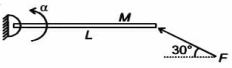
The thin rod shown below has mass $M$ and length $L$. A force $F$ acts at one end as shown and the rod is free to rotate about the other end in the plane of force. Initial angular acceleration of the rod is ........
Two rods having thermal conductivity in the ratio of $5 : 3$ having equal lengths and equal cross-sectional area are joined by face to face. If the temperature of the free end of the first rod is $100°C$ and free end of the second rod is $20°C$ . Then temperature of the junction is...... $^oC$
A heave uniform rod Is hanging vertically form a foxed support. It is stretched by its won weight. The diameter of the rod is.
A bimetallic strip consists of metals $A$ and $B$. It is mounted rigidly as shown. The metal $A$ has higher coefficient of expansion compared to that of metal $B$. When the bimetallic strip is placed in a cold both, it will :
Taking into account of the slgnificant figures, what is the value of $9.99\, m -0.0099\, m ?$
For adiabatic processes $\left( {\gamma = \frac{{{C_p}}}{{{C_v}}}} \right)$
$A$ force exerts an impulse $I$ on a particle changing its speed from $u$ to $2u$. The applied force and the initial velocity are oppositely directed along the same line. The work done by the force is
A body of mass $m$ is rotating in a vertical circle of radius $'r\ '$ with critical speed. The difference in its $K.E.$ at the top and the bottom is $.............$
A vertical rod $AC,$ with $C$ at ground and $A$ being the top most point is moving in such a way, that $A$ moves with a speed of $8\ m/ s,$ mid point of the rod $B$ moves with a speed of $4\ m/ s$. along the same direction, with what velocity will the point $C$ move:
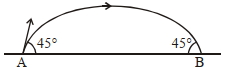
The projectile motion of a particle of mass $5\, g$ is shown in the figure.

The initial velocity of the particle is $5 \sqrt{2}\, ms ^{-1}$ and the air resistance is assumed to be negligible. The magnitude of the change in momentum between the points $A$ and $B$ is $x \times 10^{-2}\, kgms ^{-1} .$ The value of $x ,$ to the nearest integer, is ...... .