Stress vs strain curve for the elastic tissue of the aorta, the large tube (vessel) carrying blood from the heart, will be : [stress is proportional to square of the strain for the elastic tissue of the aorta]
- A
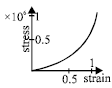
- B
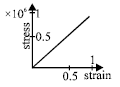
- C
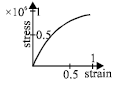
- D
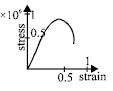
Medium


Download our appand get started for free
Experience the future of education. Simply download our apps or reach out to us for more information. Let's shape the future of learning together!No signup needed.*
Similar Questions
- 1A mild steel wire of length $2l$ meter cross-sectional area $A \;m ^2$ is fixed horizontally between two pillars. A small mass $m \;kg$ is suspended from the mid point of the wire. If extension in wire are within elastic limit. Then depression at the mid point of wire will be .............View Solution
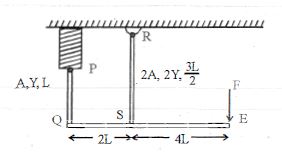
- 2A rigid massless rod of length $6\ L$ is suspended horizontally by means of two elasticrods $PQ$ and $RS$ as given figure. Their area of cross section, young's modulus and lengths are mentioned in figure. Find deflection of end $S$ in equilibrium state. Free end of rigid rod is pushed down by a constant force . $A$ is area of cross section, $Y$ is young's modulus of elasticityView Solution
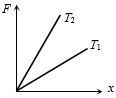
- 3The diagram shows the change $x$ in the length of a thin uniform wire caused by the application of stress $F$ at two different temperatures $T_1$ and $T_2$. The variations shown suggest thatView Solution
- 4Two wires of same diameter of the same material having the length $l$ and $2l.$ If the force $ F$ is applied on each, the ratio of the work done in the two wires will beView Solution
- 5View SolutionThe following four wires are made of the same material. Which of these will have the largest extension when the same tension is applied ?
- 6Young's moduli of the material of wires $A$ and $B$ are in the ratio of $1: 4$, while its area of cross sections are in the ratio of $1: 3$. If the same amount of load is applied to both the wires, the amount of elongation produced in the wires $A$ and $B$ will be in the ratio ofView Solution
[Assume length of wires $A$ and $B$ are same]
- 7A thick rope of density $\rho$ and length $L$ is hung from a rigid support. The Young's modulus of the material of rope is $Y$. The increase in length of the rope due to its own weight isView Solution
- 8In a series combination of copper and steel wires of same length and same diameter, a force is applied at one of their ends while the other end is kept fixed. The combined length is increased by $2\, cm$. The wires will have ..........View Solution
- 9Force constant of a spring $(K)$ is synonymous toView Solution
- 10The ratio of the lengths of two wires $A$ and $B$ of same material is $1 : 2$ and the ratio of their diameter is $2 : 1.$ They are stretched by the same force, then the ratio of increase in length will beView Solution