Question
Suppose an attractive nuclear force acts between two protons which may be written as $\text{F}=\text{Ce}^{-\text{kr}}/\text{r}^2.$
  1. Write down the dimensional formulae and appropriate SI units of C and k.
  2. Suppose that k = 1 fermi-1 and that the repulsive electric force between the protons is just balanced by the attractive nuclear force when the separation is 5 fermi. Find the value of C.
Answer

Expression of electrical force $\text{F}=\text{C}\times\text{e}^{\frac{-\text{kr}}{\text{r}^2}}$
Since e-kr is a pure number. So, dimensional formulae of $\text{F}=\frac{\text{dimensional formulae of C}}{\text{dimensional formulae of r}^2}$
Or, $\big[\text{MLT}^{-2}\big]\big[\text{L}^2\big]=$ dimensional formulae of $\text{C}=\big[\text{ML}^3\text{T}^{-2}\big]$
Unit of C = unit of force × unit of r2 = Newton × m2 = Newton-m2
Since -kr is a number hence dimensional formulae of
$\text{k}=\frac{1}{\text{dim entional formulae of r}}=\big[\text{L}^{-1}\big]$ Unit of k = m-1

Need a full question paper?

Generate a complete, print-ready paper with questions like this in minutes — across 16+ boards, with answer keys.

Start Generating Free

Similar questions

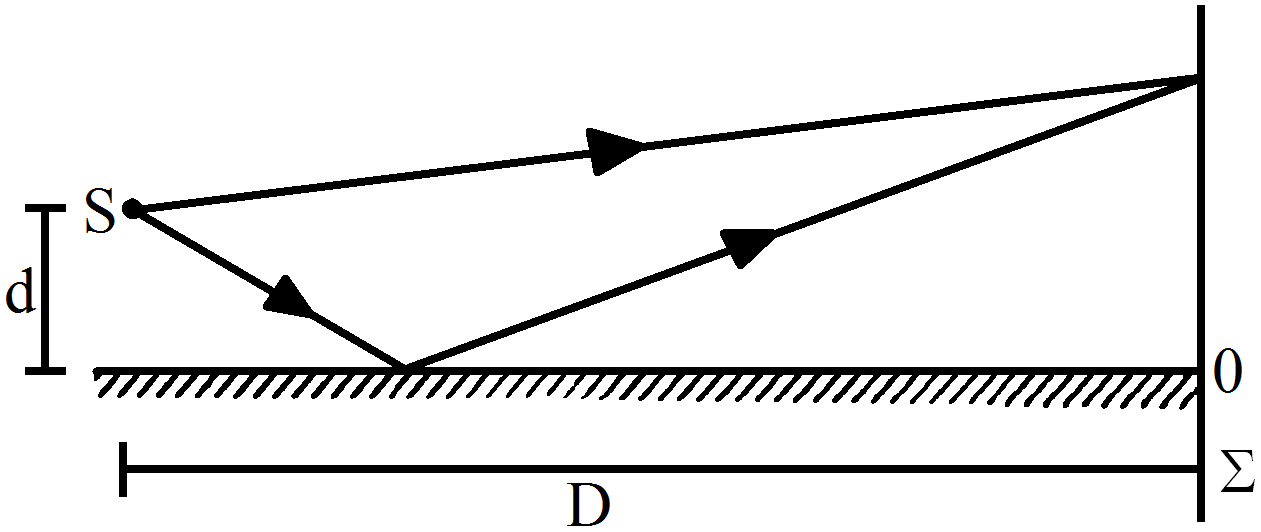
A narrow slit S transmitting light of wavelength $\lambda$ is placed a distance d above a large plane mirror as shown in figure (17-E1). The light coming directly from the slit and that coming after the reflection interfere at a screen $\sum$ placed at a distance D from the slit.

  1. What will be the intensity at a point just above the mirror, i.e., just above O?
  2. At what distance from 0 does the first maximum occur?
Draw the circuit diagram of a full-wave rectifier. Explain full-wave rectification in brief. Also draw input-output waveforms.
The work function of caesium is 2.14 eV . Find
(a) The threshold frequency for caesium.
(b) The wavelength of incident light if photocurrent is brought to zero by a stopping potential of $0.60 V .\left( h =6.625 \times 10^{-34} Js \right)$
Draw a circuit diagram of a transistor amplifier in CE configuration.
Define the terms: (i) Input resistance and (ii) Current amplification factor. How are these determined using typical input and output characteristics?
A given galvanometer is to be converted into (i) an ammeter (ii) a milliammeter (iii) a voltmeter. In which case will the required resistance be (i) least (ii) highest and why?
Give explanation of Conductor, Semiconductor and insulator on the basis of band theory.
In a children's park a heavy rod is pivoted at the centre and is made to rotate about the pivot so that the rod always remains horizontal. Two kids hold the rod near the ends and thus rotate with the rod (fig). Let the mass of each kid be 15 kg, the distance between the points of the rod where the two kids hold it be 3.0 m and suppose that the rod rotates at the rate of 20 revolutions per minute. Find the force of friction exerted by the rod on one of the kids.

A parallel plate capacitor is charged to a potential difference V from a direct current source, while there is air between the plates. Without separating the capacitor from the battery, a dielectric medium of dielectric constant K has been filled in place of air. Explain with reasons which of the following changes will occur? Also give explanation of the answers.(i) Potential difference (ii) Electric field between the plates (iii) Capacitance (iv) charge (v) energy.
Write any four characteristics of electromagnetic waves. Give two uses each of (i) Radio-waves (ii) Micro-waves.
What is space wave propagation? State the factors which limit its range of propagation. Derive an expression for the maximum line of sight distance between two antennas for space wave propagation.