Question
Suppose in an imaginary world the angular momentum is quantized to be even integral multiples of $\frac{\text{h}}{2\pi}$ What is the longest possible wavelength emitted by hydrogen atoms in visible range in such a world according to Bohr's model?
Answer

Even quantum numbers are allowed,
$\text{n}_1=2,\text{n}_2=4\xrightarrow{\ \ \ }$ For minimum energy or for longest possible wavelength.
$\text{E}=13.6\bigg(\frac{1}{\text{n}^2_1}-\frac{1}{\text{n}^2_2}\bigg)$
$\text{E}=13.6\Big(\frac{1}{2^2}-\frac{1}{4^2}\Big)=2.55$
$2.55=\frac{\text{hc}}{\lambda}$
$\lambda=\frac{\text{hc}}{2.55}=\frac{1242}{2.55}$
$\lambda=487.05\text{nm}=487\text{nm}$

Need a full question paper?

Generate a complete, print-ready paper with questions like this in minutes — across 16+ boards, with answer keys.

Start Generating Free

Similar questions

While watering a distant plant, a gardener partially water than in fresh closes the exit hole of the pipe by putting his finger on it. Explain why this results in the water stream goirig to a larger distance.
Out of the two magnetic materials, 'A' has relative permeability slightly greater than unity while 'B' has less than unity. Identify the nature of the materials 'A' and 'B'. Will their susceptibilities be positive or negative?
Huygen's principle is the basis of wave theory of light. Each point on a wavefront acts as a fresh source of new disturbance, called secondary waves or wavelets. The secondary wavelets spread out in all directions with the speed light in the given medium.
An initially parallel cylindrical beam travels in a medium of refractive index $\mu(\text{I})=\mu_0+\mu_2\text{I}$, where $\mu_0$ and $\mu_2$ are positive constants and I is the intensity of the light beam. The intensity of the beam is decreasing with increasing radius.
  1. The initial shape of the wavefront of the beam is:
  1. Planar.
  2. Convex.
  3. Concave.
  4. Convex near the axis and concave near the periphery.
  1. According to Huygens Principle, the surface of constant phase is:
  1. Called an optical ray.
  2. Called a wave.
  3. Called a wavefront.
  4. Always linear in shape.
  1. As the beam enters the medium, it will:
  1. Travel as a cylindrical beam.
  2. Diverge.
  3. Converge.
  4. Diverge near the axis and converge near the periphery.
  1. Two plane wavefronts oflight, one incident on a thin convex lens and another on the refracting face of a thin prism. After refraction at them, the emerging wavefronts respectively become.
  1. Plane wavefront and plane wavefront.
  2. Plane wavefront and spherical wavefront.
  3. Spherical wavefront and plane wavefront.
  4. Spherical wavefront and spherical wavefront.
  1. Which of the following phenomena support the wave theory of light?
  1. Scattering.
  2. Interference.
  3. Diffraction.
  4. Velocity of light in a denser medium is less than the velocity of light in the rarer medium.
  1. 1, 2, 3
  2. 1, 2, 4
  3. 2, 3, 4
  4. 1, 3, 4
A metallic loop is placed in a nonuniform magnetic field. Will an emf be induced in the loop?
Discuss the Einstien's explanation for the photoelectric effect.
Wavefront is a locus of points which vibratic in same phase. A ray of light is perpendicular to the wavefront. According to Huygens principle, each point of the wavefront is the source of a secondary disturbance and the wavelets connecting from these points spread out in all directions with the speed of wave.
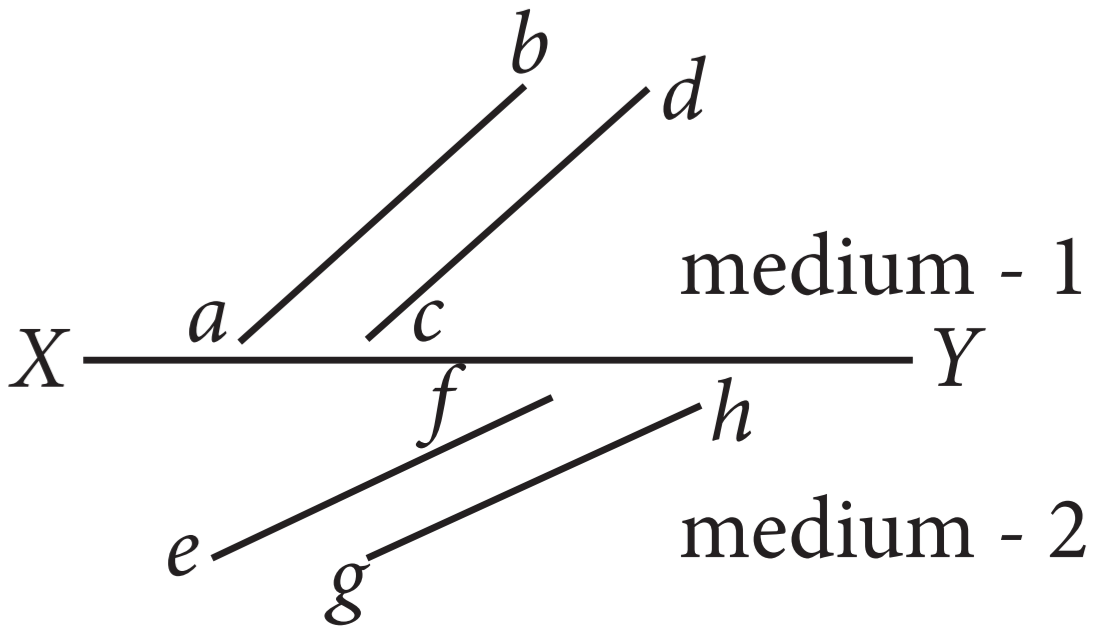
The figure shows a surface XY separating two transparent media, medium-I and medium-2. The lines ab and cd represent wavefronts of a light wave travelling in medium- 1 and incident on XY. The lines ef and gh represent wavefronts of the light wave in medium-2 after refraction.
  1. Light travels as a:
  1. Parallel beam in each medium.
  2. Convergent beam in each medium.
  3. Divergent beam in each medium.
  4. Divergent beam in one medium and convergent beam in the other medium.
  1. The phases of the light wave at c, d, e and f are $\phi_\text{c},\phi_\text{d},\phi_\text{e}$ and $\phi_\text{f}$ respectively. It is given that $\phi_\text{c}\not=\phi_\text{f}$
  1. $\phi_\text{c}$ cannot be equal $\phi_\text{d}$
  2. $\phi_\text{d}$ cannot be equal $\phi_\text{e}$
  3. $(\phi_\text{d}-\phi_\text{f})$ is equal to $(\phi_\text{c}-\phi_\text{e})$
  4. $(\phi_\text{d}-\phi_\text{c})$ is not equal to $(\phi_\text{f}-\phi_\text{e})$
  1. Wavefront is the locus of all points, where the particles of the medium vibrate with the same.
  1. Phase
  2. Amplitude
  3. Frequency
  4. Period
  1. A point source that emits waves uniformly in all directions, produces wavefronts that are:
  1. Spherical
  2. Elliptical
  3. Cylindrical
  4. Planar
  1. What are the types of wavefronts?
  1. Spherical
  2. Cylindrical
  3. Plane
  4. All of these.
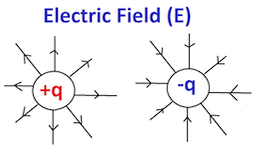
Electric field intensity at any point is the strength of the electric field at that point. It is also defined as the force experienced by unit positive charge placed at that point. Electric Field Intensity is a vector quantity. It is denoted by E. When placed within the electric field, the test charge will experience an electric force - either attractive or repulsive.
Image
(i) The Electric field at a point is
(a) discontinuous only if there is a negative charge at that point
(b) always continuous
(c) continuous if there is charge at that point
(d) continuous if there is no charge at that point

(ii) A charge is distributed uniformly over a ring of radius a. Obtain an expression for the electric intensity E at a point on the axis of the ring. Hence the points at large distances from the ring, it behaves like a point charge is:
(a) $E =\frac{1}{4 \pi \varepsilon_0} \cdot \frac{q}{x}$
(b) $E =\frac{1}{2 \pi \varepsilon_0} \cdot \frac{Q}{x^2}$
(c) $E =\frac{1}{4 \pi \varepsilon_0} \cdot \frac{q}{x^4}$
(d) $E =\frac{1}{4 \pi \varepsilon_0} \cdot \frac{Q}{x^2}$

(iii) Force acting on an electron in a uniform electric field of $5 \times 10^4 N / C$ is:
(a) $8 \times 10^{-15} N$
(b) $-7 \times 10^{-15} N$
(c) $-8 \times 10^{-15} N$
(d) $7 \times 10^{-15} N$

(iv) At a particular point, the electric field depends upon:
(a) source charge Q only
(b) both Q and q
(c) test charge $q_0$ only
(d) neither Q nor q

OR

Four charges of the same magnitude and same sign are placed at the corners of a square, of each side 0.1 m. then electric field intensity at the centre of the square is:
(a) $0.01 N / C$
(b) $0.25 N / C$
(c) zero
(d) $0.1 N / C$

A player hits a baseball at some angle. The ball goes high up in space. The player runs and catches the ball before it hits the ground. Which of the two (the player or the ball) has greater displacement?
The needle of a dip circle shows an apparent dip of 45° in a particular position and 53° when the circle is rotated through 90°. Find the true dip.
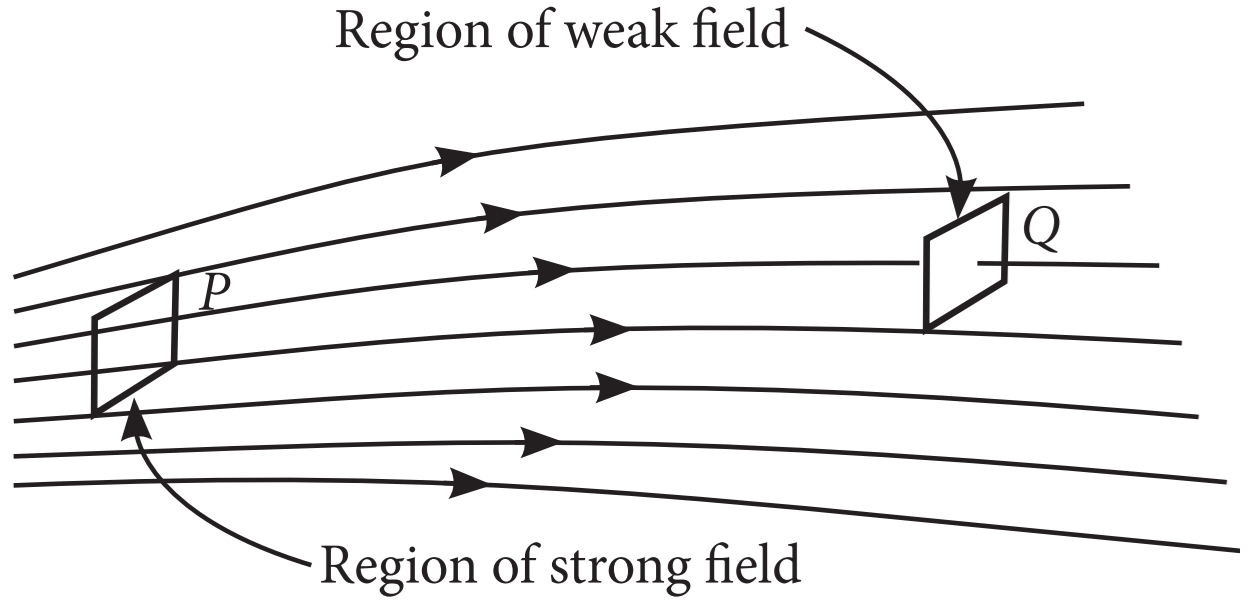
Electric field strength is proportional to the density of lines of force i.e., electric field strength at a point is proportional to the number of lines of force cutting a unit area element placed normal to the field at that point. As illustrated in the given figure, the electric field at $P$ is stronger that at $Q$.
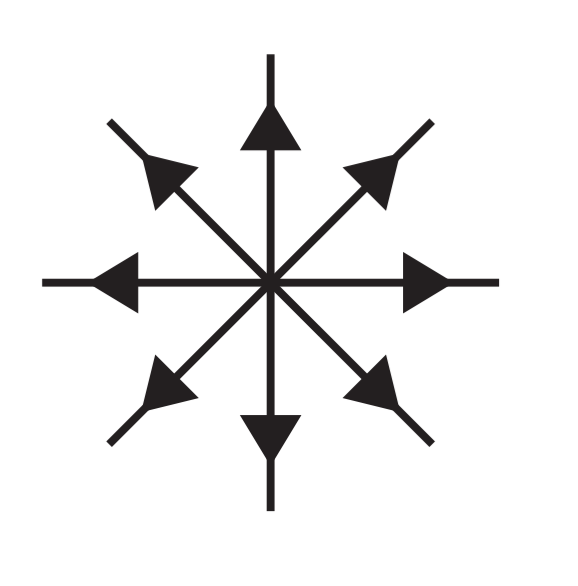
  1. Electric lines of force about a positive point charge are:
  1. Radially outwards.
  2. Circular clockwise.
  3. Radially inwards.
  4. Parallel straight lines.
  1. Which of the following is false for electric lines of force?
  1. They always start from positive charges and terminate on negative charges.
  2. They are always perpendicular to the surface of a charged conductor.
  3. They always form closed loops.
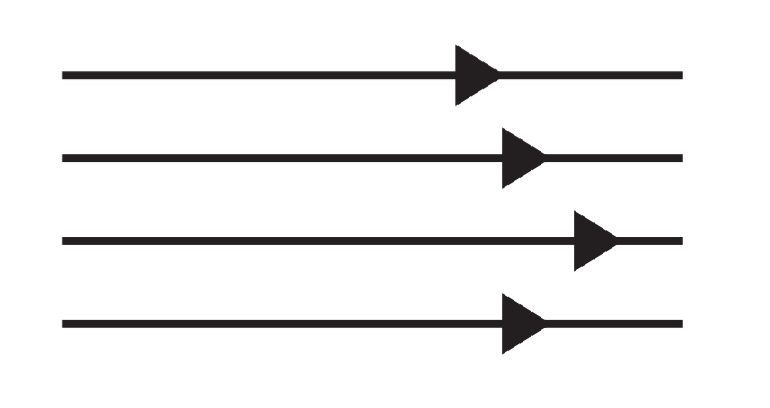
  4. They are parallel and equally spaced in a region of uniform electric field.
  1. Which one of the following pattern of electric line of force in not possible in filed due to stationary charges?
  1.  
  1.  
  1.  
  1.  
  1. Electric lines of force are curved:
  1. In the field of a single positive or negative charge.
  2. In the field of two equal and opposite charges.
  3. In the field of two like charges.
  4. Both $(b)$ and $(c).$
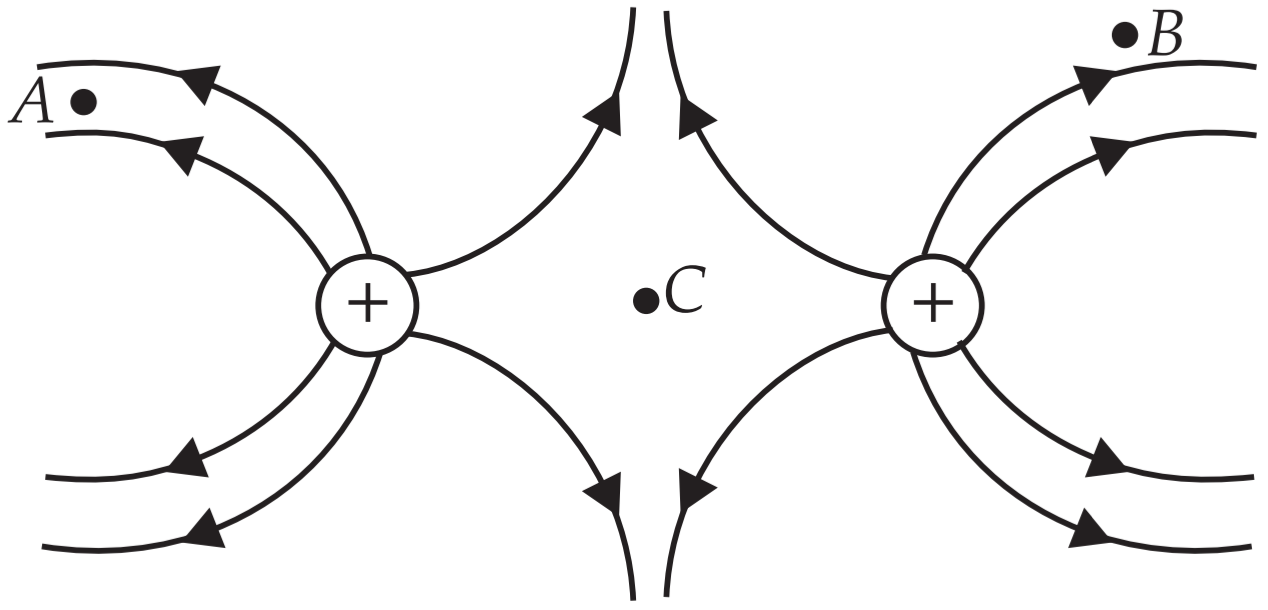
  1. The figure below shows the electric field lines due to two positive charges.
  2. The magnitudes $E_A, E_B$ and $E_C$​​​​​​​ of the electric fields at points $A, B$ and $C$ respectively are related as:
  1. $E_A > E_B > E_C$
  2. $E_B > E_A > E_C$
  3. $E_A = E_B > E_C$
  4. $E_A > E_B = E_C$