Question
Test if the following equations are dimensionally correct:
  1. $\text{h}=\frac{2\text{S}\cos\theta}{\rho\text{rg}}$
  2. $\text{u}=\sqrt{\frac{\text{P}}{\rho}}$
  3. $\text{V}=\frac{\pi\text{Pr}^4\text{t}}{8\eta l}$
  4. $\text{v}=\frac{1}{2\pi}\sqrt{\frac{\text{mg}l}{\text{I}}}$
where h = height, S = surface tension, $\rho$ = density, P = pressure, V = volume, $\eta$ = coefficient of viscosity, v = frequency and I = moment of inertia.

Answer

  1. $\text{h}=\frac{2\text{S}\cos\theta}{\rho\text{rg}}$
$\text{LHS}=[\text{L}]$

Surface tension $=\text{S}=\frac{\text{F}}{\text{I}}=\frac{\text{MLT}^{-2}}{\text{L}}=[\text{MT}^{-2}]$

Density $=\rho=\frac{\text{M}}{\text{V}}=[\text{ML}^{-3}\text{T}^{0}]$

Radius $=\text{r}=[\text{L],g = [LT}^{-2}]$

$\text{RHS}=\frac{2\text{S}\cos\theta}{\rho\text{rg}}=\frac{[\text{MT}^{-2}]}{[\text{ML}^{-3}\text{T}^0][\text{L}][\text{LT}^{-2}]}=[\text{M}^0\text{L}^1\text{T}^0]=[\text{L}]$

$\text{LHS = RHS}$

So, the relation is correct
  1. $\text{v}=\sqrt{\frac{\text{P}}{\rho}}$ where v = velocity
$\text{LHS = Dimension of v = [LT}^{-1}]$

Dimension of $\text{p}=\frac{\text{F}}{\text{A}}=[\text{ML}^{-1}\text{T}^{-2}]$

Dimension of $\rho=\frac{\text{m}}{\text{v}} = \text{[ML}^{-2}]$

$\text{RHS}=\sqrt{\frac{\text{p}}{\rho}}=\sqrt{\frac{[\text{ML}^{-1}\text{T}^{-2}]}{[\text{ML}^{-3}]}}=[\text{L}^2\text{T}^{-2}]^{\frac{1}{2}}=[\text{LT}^{-1}]$

So, the relation is correct.
  1. $\text{V}=\frac{(\pi\text{pr}^4\text{t})}{(8\eta\text{I})}$
$\text{LHS = Dimension of V = [L}^3]$

Dimension of $\text{p}=[\text{ML}^{-1}\text{T}^{-2}],\text{r}^4=[\text{L}^4],\text{t}=[\text{T}]$

Coefficient of viscosity $=[\text{ML}^{-1}\text{T}^{-1}]$

$\text{RHS}=\frac{\pi\text{pr}^4\text{t}}{8\eta\text{I}}=\frac{[\text{ML}^{-1}\text{T}^{-2}][\text{L}^4][\text{T}]}{[\text{ML}^{-1}\text{T}^{-1}][\text{L}]}$

So, the relation is correct.
  1. $\text{v}=\frac{1}{2\pi}\sqrt{(\text{mgI}/\text{I})}$
$\text{LHS = dimension of v = [T}^{-1}]$

$\text{RHS}=\sqrt{(\text{mgI}/\text{I})}=\sqrt{\frac{[\text{M}][\text{LT}^{-2}][\text{L}]}{[\text{ML}^2]}}=[\text{T}^{-1}]$

$\text{LHS = RHS}$

So, the relation is correct.

Need a full question paper?

Generate a complete, print-ready paper with questions like this in minutes — across 16+ boards, with answer keys.

Start Generating Free

Similar questions

$4 \times 10^{23}$ tritium atoms are contained in a vessel. The half-life of decay tritium nuclei is 12.3y. Find:
  1. The activity of the sample.
  2. The number of decay in the next 10 hours.
  3. The number of decays in the next 6.15y.
Two capacitors of capacitances 20.0pF and 50.0pF are connected in series with a 6.00V battery. Find:
  1. The potential difference across each capacitor.
  2. The energy stored in each capacitor.
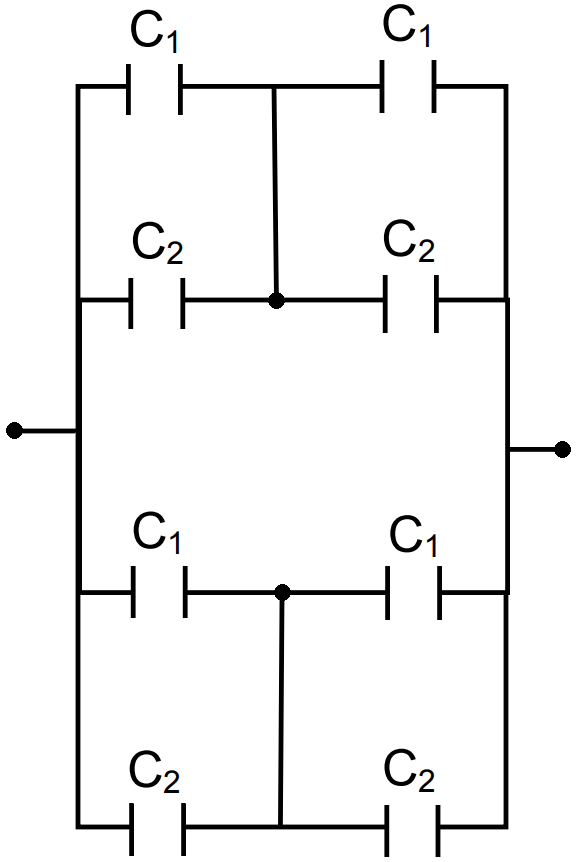
Take $\text{C}_1=4.0\mu\text{F}$ and $\text{C}_2=6.0\mu\text{F}$ in figure. Calculate the equivalent capacitance of the combination between the points indicated.

A particle of mass m and charge q is thrown at a speed u against a uniform electric field E. How much distance will it travel before coming to momentary rest?
Explain ac voltage applied on a capacitor.Explain charging and discharging of a capacitor.
An electric field is uniform, and in the positive $x$ direction for positive $x$, and uniform with the same magnitude but in the negative $x$ direction for negative $x$. It is given that $E =200 \hat{ i } N / C$ for $x>0$ and $E =-200 \hat{ i } N / C$ for $x<0$. A right circular cylinder of length $20 \ cm$ and radius $5 \ cm$ has its centre at the origin and its axis along the $x-$ axis so that one face is at $x=+10 \ cm$ and the other is at $x=-10 \ cm\  ($Fig. $1.25).\ (a)$ What is the net outward flux through each flat face? $(b)$ What is the flux through the side of the cylinder? $(c)$ What is the net outward flux through the cylinder? $(d)$ What is the net charge inside the cylinder?
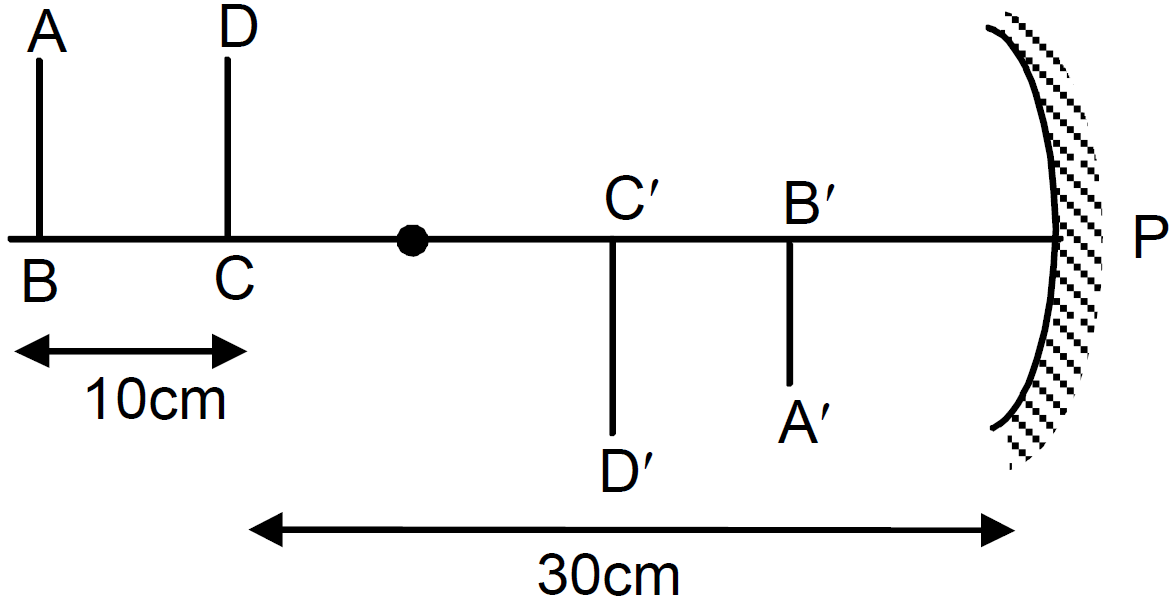
A U-shaped wire is placed before a concave mirror having radius of curvature 20cm. Find the total length of the image.
Suppose a 'n' - type wafer is created by doping Si crystal having $5 \times 10^{28} atoms/m^3$ with 1ppm concentration of As. On the surface 200 ppm Boron is added to create ‘P’ region in this wafer. Considering $n_i = 1.5 \times 10^{16}m^{-3}.$
  1. Calculate the densities of the charge carriers in the n & p regions.
  2. Comment which charge carriers would contribute largely for the reverse saturation current when diode is reverse biased.
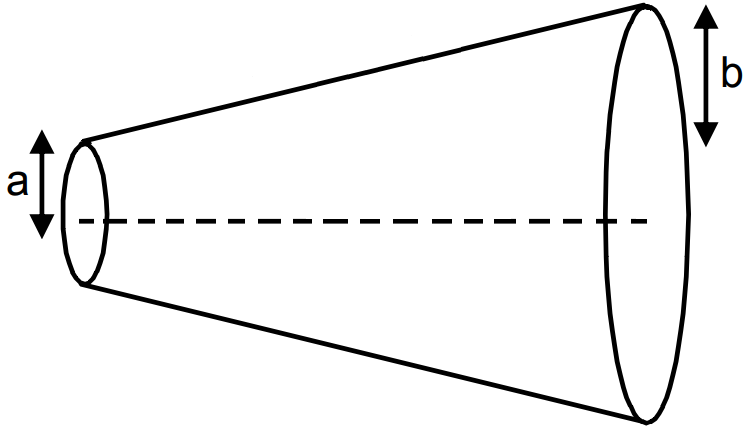
Figure. shows a conductor of length l with a circular cross-section. The radius of the cross-section varies linearly from a to b. The resistivity of the material is ρ. Assuming that b - a << l, find the resistance of the conductor.
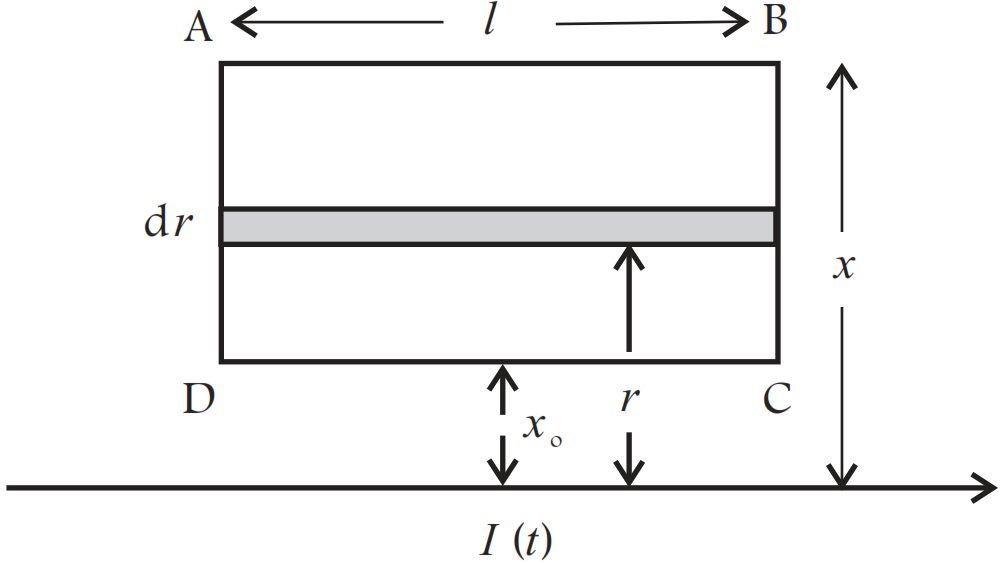
Consider an infinitely long wire carrying a current I (t), with $\frac{\text{dI}}{\text{dt}}=\lambda=\text{constant}$. Find the current produced in the rectangular loop of wire ABCD if its resistance is R (Fig).