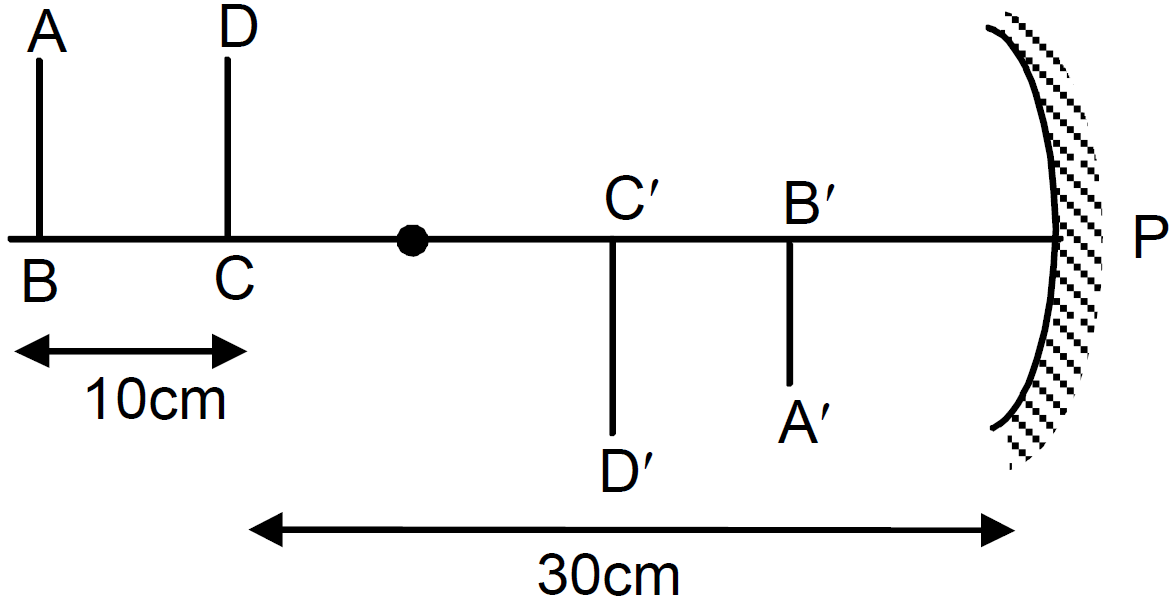
A U-shaped wire is placed before a concave mirror having radius of curvature 20cm. Find the total length of the image.
Download our app for free and get started
 $\text{R}=20\text{cm}, \ \text{f}=\frac{\text{R}}{2}=-10\text{cm}$ For part AB, PB = 30 + 10 = 40cm So, $\text{u}=-40\text{cm}$$\Rightarrow\frac{1}{\text{v}}=\frac{1}{\text{f}}-\frac{1}{\text{u}}=-\frac{1}{10}-\Big(\frac{1}{-40}\Big)=-\frac{3}{40}$
$\Rightarrow\text{v}=-\frac{40}{3}=-13.3\text{cm}$ So, PB' = 13.3cm $\text{m}=\frac{\text{A}'\text{B}'}{\text{AB}}=-\Big(\frac{\text{v}}{\text{u}}\Big)=-\Big(\frac{-13.3}{-40}\Big)=-\frac{1}{3}$ $\Rightarrow\text{A}'\text{B}'=-\frac{10}{3}=-3.33\text{cm}$ For part CD, PC = 30, So, u = -30cm $\frac{1}{\text{v}}=\frac{1}{\text{f}}-\frac{1}{\text{u}}=-\frac{1}{10}+\frac{1}{-30}=-\frac{1}{15}$ $\Rightarrow\text{v}=-15\text{cm}=\text{PC}'$ So, $\text{m}=\frac{\text{C}'\text{D}'}{\text{CD}}=-\frac{\text{v}}{\text{u}}=-\Big(\frac{-15}{-30}\Big)=-\frac{1}{2}$ $\Rightarrow\text{C}'\text{D}'=5\text{cm}$ B'C' = PC' - PB' = 15 - 13.3 = 17cm So, total length A'B' + B'C' + C'D' = 3.3 + 1.7 + 5 = 10cm.

Download our appand get started for free
Experience the future of education. Simply download our apps or reach out to us for more information. Let's shape the future of learning together!No signup needed.*
Similar Questions
- 1View SolutionDetermine the ‘effective focal length’ of the combination of the two lenses in if they are placed 8.0 cm apart with their principal axes coincident. Does the answer depend on which side of the combination a beam of parallel light is incident? Is the notion of effective focal length of this system useful at all.
- 2A thin prism of angle $6.0^\circ,\omega=0.07$ and $\mu_\text{y}=1.50$ is combined with another thin prism having $\omega=0.08$ and $\mu_\text{y}=1.60.$ The combination produces no deviation in the mean ray.View Solution
- Find the angle of the second prism.
- Find the net angular dispersion produced by the combination when a beam of white light passes through it.
- If the prisms are similarly directed, what will be the deviation in the mean ray
- Find the angular dispersion in the situation described in (c).
- 3View SolutionUse the mirror equation to deduce that:
- an object placed between f and 2f of a concave mirror produces a real image beyond 2f.
- a convex mirror always produces a virtual image independent of the location of the object.
- the virtual image produced by a convex mirror is always diminished in size and is located between the focus and the pole.
- 4View SolutionA gun of mass M fires a bullet of mass m with a horizontal speed V. The gun is fitted with a concave mirror of focal length f facing tpwards the receding bullet. Find the speed of separation of the bullet and the image just after the gun was fired.
- 5A ball is kept at a height h above the surface of a heavy transparent sphere made of a material of refractive index $\mu.$ The radius of the sphere is R. At t = 0, the ball is dropped to fall normally on the sphere. Find the speed of the image formed as a function of time for $\text{t}<\sqrt{\frac{2\text{h}}{\text{g}}}.$ Consider only the image by a single refraction.View Solution
- 6View SolutionIn many experimental set-ups the source and screen are fixed at a distance say D and the lens is movable. Show that there are two positions for the lens for which an image is formed on the screen. Find the distance between these points and the ratio of the image sizes for these two points.
- 7View Solution
- Draw a labelled ray diagram to show the formation of image in an astronomical telescope for a distant object.
- Write three distinct advantages of a reflecting type telescope over a refracting type telescope.
- A convex lens of focal length 10 cm is placed coaxially 5 cm away from a concave lens of focal length 10 cm. If an object is placed 30 cm in front of the convex lens, find the position of the final image formed by the combined system.
- 8View Solution
- A point object is placed on the principal axis of a convex spherical surface of radius of curvature R, which separates the two media of refractive indices $n_1$ and $n_2(n_2 > n_1)$. Draw the ray diagram and deduce the relation between the object distance (u), image distance (v) and the radius of curvature (R) for refraction to take place at the convex spherical surface from rarer to denser medium.
- A converging lens has a focal length of 20 cm in air. It is made of a material of refractive index 1.6. If it is immersed in a liquid of refractive index 1.3, find its new focal length.
- 9Trace the rays of light showing the formation of an image due to a point object placed on the axis of a spherical surface separating the two media of refractive indices $n_1$ and $n_2$. Establish the relation between the distances of the object, the image and the radius of curvature from the central point of the spherical surface. Hence derive the expression of the lens maker’s formula.View Solution
- 10View SolutionA normal eye has retina 2cm behind the eye-lens. What is the power of the eye-lens when the eye is
- Fully relaxed,
- Most strained?