MCQ
The accelerated motion of a body changes due to change in:
  • A
    Speed
  • B
    Direction of motion.
  • C
    Velocity.
  • All of the above

Answer

Correct option: D.
All of the above
The accelerated motion of a body changes due to a change in speed, direction of motion, velocity.
As acceleration posses magnitude and direction. Its magnitude changes by a change in speed, velocity, and direction can be changed by the direction of motion and velocity.

Need a full question paper?

Generate a complete, print-ready paper with questions like this in minutes — across 16+ boards, with answer keys.
Start Generating Free

Similar questions

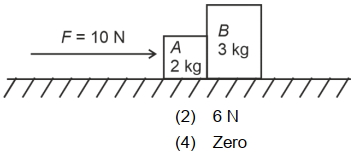
A horizontal force $10 \mathrm{~N}$ is applied to a block $A$ as shown in figure. The mass of blocks $A$ and $B$ are $2 \mathrm{~kg}$ and $3 \mathrm{~kg}$ respectively. The blocks slide over a frictionless surface. The force exerted by block $A$ on block $B$ is :
Blood velocity: The flow of blood in a large artery of an anesthetised dog is diverted through a Venturi meter. The wider part of the meter has a crosssectional area equal to that of the artery. $A = 8\; mm^2$. The narrower part has an area $a = 4 \;mm^2$. The pressure drop in the artery is $24\; Pa$. What is the speed (in $m/s$) of the blood in the artery?
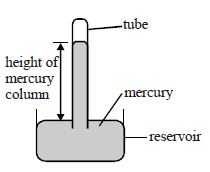
The diagram shows a simple mercury barometer.Which of the following does not cause the height of the mercury column to vary ?
Which of the following systems of units is not based on units of mass, length and time alone?
The mean square speed of the molecules of a gas at absolute temperature T is proportional to:
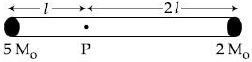
A rigid massless road of length $3l$ has tow masses attached at each end as shown in the figure. The rod is pivoted at point $P$ on the horizontal axis (see figure). When released from initial horizontal position, its instantaneous angular acceleration will be
We consider the radiation emitted by the human body. Which of the following statements is true
A body of mass $1\,kg$ is projected with velocity $50\,m / s$ at an angle of $30^{\circ}$ with the horizontal. At the highest point of its path a force $10\,N$ starts acting on body for $5\,s$ vertically upward besides gravitational force, what is horizontal range of the body? $\left(g=10\,m/s^2\right)$
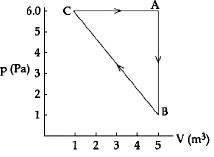
For the given cyclic process $CAB$ as shown for a gas, the work done is ..... $J$
A body weighs $700 \,gm$ wt on the surface of the earth. How much will it weigh on the surface of a planet whose mass is $\frac{1}{7}$ and radius is half that of the earth ........ $gm\, wt$