MCQ
The accelerated motion of a body changes due to change in:
  • A
    Speed
  • B
    Direction of motion.
  • C
    Velocity.
  • D
    All of the above

Answer

  1. All of the above

Explanation:

The accelerated motion of a body changes due to a change in speed, direction of motion, velocity.

As acceleration posses magnitude and direction. Its magnitude changes by a change in speed, velocity, and direction can be changed by the direction of motion and velocity.

Need a full question paper?

Generate a complete, print-ready paper with questions like this in minutes — across 16+ boards, with answer keys.

Start Generating Free

Similar questions

Which of the following is true about the angular momentum of a cylinder down a slope without slipping
The velocity-time graph of a particle moving with initial velocity u and uniform acceleration a is:
A vector $\overrightarrow{ A }$ points vertically upward and $\overrightarrow{ B }$ points towards north. The vector product $\overrightarrow{ A } \times \overrightarrow{ B }$ is
A particle performing uniform circular motion has angular momentum L. If its angular frequency is doubled and its kinetic energy halved, then the new angular momentum is:
While opening a tap with two fingers, the forces applied by the fingers are:
A satellite revolves in the geostationary orbit but in a direction east to west. The time interval between its successive passing about a point on the equator is ........ $hrs$
A body of mass $1\,kg$ is executing simple harmonic motion. Its displacement $y(cm)$ at $t$ seconds is given by $y = 6\sin (100t + \pi /4)$. Its maximum kinetic energy is ..... $J$
A mass $1\, kg$ is suspended by a thread. It is

$(i)\,$ lifted up with an acceleration $4.9\,m/{s^2}$

$(ii) \,$lowered with an acceleration $4.9\,m/{s^2}$.

The ratio of the tensions is
A particle moves $21\, m$ along the vector $6\hat i + 2\hat j + 3\hat k$ , then $14\, m$ along the vector $3\hat i - 2\hat j + 6\hat k$ . Its total displacement (in meters) is
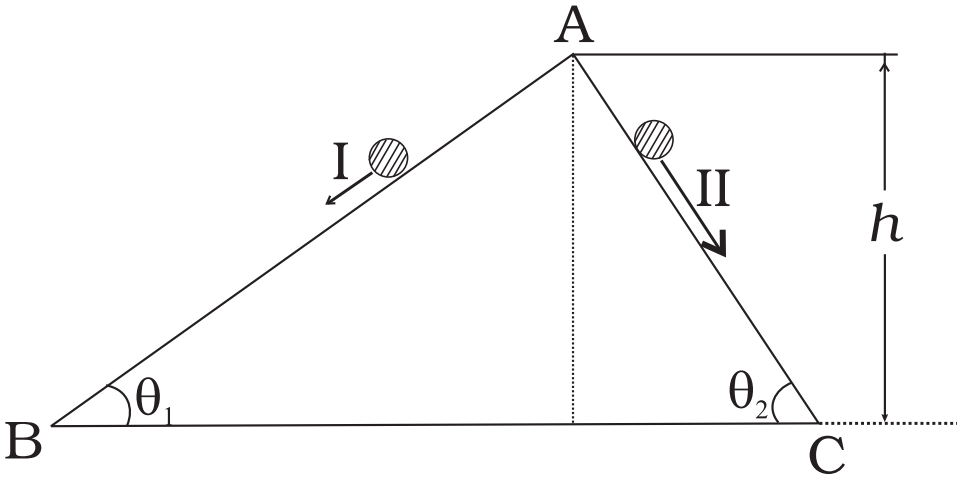
Two inclined frictionless tracks, one gradual and the other steep meet at A from where two stones are allowed to slide down from rest, one on each track as shown in which of the following statement is correct?