MCQ
The acceleration due to gravity at a place is ${\pi ^2}\,m/se{c^2}$. Then the time period of a simple pendulum of length one metre is
  • A
    $\frac{2}{\pi }\,sec$
  • B
    $2\pi \,sec$
  • $2\,sec$
  • D
    $\pi \,sec$

Answer

Correct option: C.
$2\,sec$
c
$T = 2\pi \sqrt {\frac{l}{g}}  = 2\pi \sqrt {\frac{1}{{{\pi ^2}}}} = 2 \,sec$

Need a full question paper?

Generate a complete, print-ready paper with questions like this in minutes — across 16+ boards, with answer keys.

Start Generating Free

Similar questions

A man swimming down stream overcome a float at a point $M$. After travelling distance $D$ he turned back and passed the float at a distance of $D/2$ from the point $M$, then the ratio of speed of swimmer with respect to still water to the speed of the river will be
Mass $M$ is divided into two parts $xM$ and $(1 - x)\,M$. For a given separation, the value of $x$ for which the gravitational attraction between the two pieces becomes maximum is
The pressure of an ideal gas is written as $\text{p}=\frac{2\text{E}}{3\text{v}}.$ Here $E$ refers to:
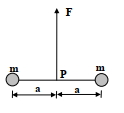
Two particle of mass $m$ each are tied at the ends of a light string of length $2 \mathrm{a}$. The whole system is kept on a frictionless horizontal surface with the string held tight so that each mass is at a distance $'a'$ from the center $\mathrm{P}$ (as shown in the figure). Now, the mid-point of the string is pulled vertically upwards with a small but constant force $F$. As a result, the particles move towards each other on the surface. The magnitude of acceleration, when the separation between them becomes $2 \mathrm{x}$ is
The velocity of the centre of mass of a rigid rod with respect to an observer $O$ is $\vec v = \left( {2\hat i + 3\hat j} \right) ms^{-1}$ . The rod has an angular velocity about its centre of mass given by $\vec \omega$  =$\left( {3\hat j + 4\hat k} \right) s^{-1}$ . Let A be a point on the rod with position vector $2\left( {\hat i + \hat k} \right) m$ with respect to the centre of mass. The velocity of the point $A$ with respect to $O$ is
A unit mass of solid converted to liquid at its melting point. Heat is required for this process is:
A large horizontal surface moves up and down in $S.H.M.$ with an amplitude of $1\, cm$. If a mass of $10\, kg$ (which is placed on the surface is to remain continuously in contact with it, the maximum frequency of $S.H.M.$ will be .... $Hz$
The only possibility of heat flow in a thermos flask is through its cork which is $75 cm^2$ in area and $5 cm$ thick. Its thermal conductivity is $0.0075 cal/cmsec^oC$. The outside temperature is$ 40^oC$ and latent heat of ice is $80 cal g^{-1}$. Time taken by $500 g$ of ice at $0^oC$ in the flask to melt into water at $0^oC$ is ....... $hr$
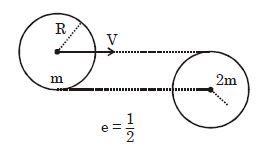
A ball of mass $m$ is moving with a speed $V$ as shown in the figure. It undergoes inelastic collision with a ball of mass $2\ m$ which was initially at rest. The velocity of ball $2\ m$ after collision will be given by
If a shell fired from a cannon, explodes in mid air, then