Question
The angle made by line $\text{r}[\cos\theta−3​\sin\theta]=5 $ with initial line is:

Answer

  1. 30°
Solution:
Given equation
$\text{r}[\cos\theta−3​\sin\theta]=5 $
$\text{x}−\sqrt{3}\text{​y}=5$
Slope of the line is $\tan\theta=\frac{1}{\sqrt{3}}​$
$\Rightarrow\theta=30^\circ$
Hence, the line makes an angle of 30° with the initial line.

Need a full question paper?

Generate a complete, print-ready paper with questions like this in minutes — across 16+ boards, with answer keys.
Start Generating Free

Similar questions

The unit vector in the direction of $\overrightarrow{\text{a}}$ is:
  1. $\frac{\vec{\text{a}}}{\mid\vec{\text{a}\mid}}$
  2. $\vec{\text{a}}\mid\vec{\text{a}}\mid$
  3. $\text{a}^{2}$
  4. $\hat{\text{i}}$
If $A=\left[\begin{array}{cc}\sin ^2 \theta & \sec ^2 \theta \\ \operatorname{cosec}^2 \theta & \frac{1}{2}\end{array}\right]$ and $B=\left[\begin{array}{cc}\cos ^2 \theta & -\tan ^2 \theta \\ -\cot ^2 \theta & \frac{1}{2}\end{array}\right]$ the value of $A + B$ will be :
The feasible region for an LPP is always a ______ polygon.
$\int\frac{1}{1-\cos\text{x}-\sin\text{x}}\text{ dx}=$
  1. $\log\big|1+\cot\frac{\pi}{2}\big|+\text{C}$
  2. $\log\big|1-\tan\frac{\pi}{2}\big|+\text{C}$
  3. $\log\big|1-\cot\frac{\pi}{2}\big|+\text{C}$
  4. $\log\big|1+\tan\frac{\pi}{2}\big|+\text{C}$
If $A=\left[a_{i j}\right]$ is a square matrix of order 2 such that $a_{i j}=\left\{\begin{array}{ll}1, & \text { when } i \neq j \\ 0, & \text { when } i=j\end{array}\right.$ then $A^2$ is
The distance between the planes $2x + 2y - z +2 = 0$ and $4x + 4y - 2z + 5 = 0$ is:
If $A=\left[\begin{array}{lll}2 & -3 & 4\end{array}\right], B=\left[\begin{array}{l}3 \\ 2 \\ 2\end{array}\right], X=\left[\begin{array}{lll}1 & 2 & 3\end{array}\right]$ and $Y=\left[\begin{array}{l}2 \\ 3 \\ 4\end{array}\right]$, then $A B+X Y$ equals
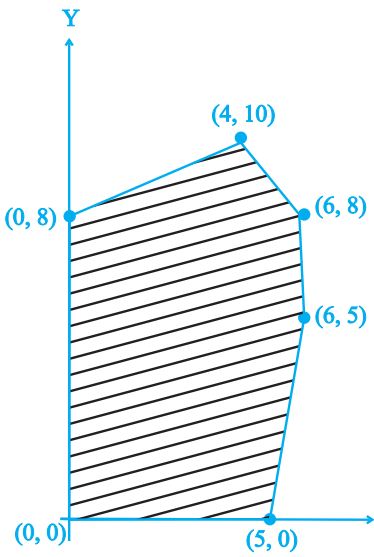
Choose the correct answer from the given four options. The feasible solution for a LPP is shown in. Let Z = 3x - 4y be the objective function.
Maximum of Z occurs at:
Let * be a binary operation defined on set Q − {1} by the rule a * b = a + b − ab. Then, the identify element for * is:
  1. $1$
  2. $\frac{\text{a}-1}{\text{a}}$
  3. $\frac{\text{a}}{\text{a}-1}$
  4. $0$
A relation $R$ in set $A=\{1,2,3\}$ is defined as $R=\{(1,1),(1,2),(2,2),(3,3)\}$. Which of the following ordered pair in $R$ shall be removed to make it an equivalence relation in $A$ ?