MCQ
The angular frequency of an AC source is $\frac{10\text{radian}}{\text{sec}}$ The reactance of $1\mu\text{F}$ capacitor will be.
- A$10^4\Omega$
- B$10^2\Omega$
- C$10^1\Omega$
- D$10^5\Omega$
Explanation:
$\text{Reactance}=\frac{1}{\text{C}\omega}\Omega$
$=\frac{1}{10^{-6}\times10}=\frac{1}{10^{-5}}$
$=10^5\Omega$
Generate a complete, print-ready paper with questions like this in minutes — across 16+ boards, with answer keys.
The following configuration of gate is equivalent to
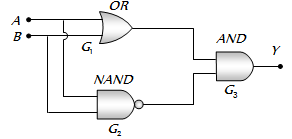
|
(a) NAND |
(b) XOR |
(c) OR |
(d) None of these |
The intensity of X-rays from a Coolidge tube is plotted against wavelength as shown in the figure. The minimum wavelength found is  and the wavelength of the
  line is
  . As the accelerating voltage is increased
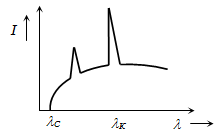
|
(a) ( |
(b) ( |
(c) |
(d) |
A charge q is moving in a magnetic field then the magnetic force does not depend upon
|
(a) Charge |
(b) Mass |
(c) Velocity |
(d) Magnetic field |
During a negative beta decay
|
(a) An atomic electron is ejected |
|
(b) An electron which is already present within the nucleus is ejected |
|
(c) A neutron in the nucleus decays emitting an electron |
|
(d) A part of the binding energy is converted into electron |
A study of binary stars is most helpful in
|
(a) Finding their distances |
(b) Finding their temperature |
|
(c) Finding their masses |
(d) Verifying Newton's force law of gravitation |

