MCQ
The angular speed of earth around its own axis is ......... $rad / s$
  • $\frac{\pi}{43200}$
  • B
    $\frac{\pi}{3600}$
  • C
    $\frac{\pi}{86400}$
  • D
    $\frac{\pi}{1800}$

Answer

Correct option: A.
$\frac{\pi}{43200}$
a
(a)

Angular speed $=\frac{2 \pi}{T}$

$T \rightarrow$ Time period of earth $=24 h$

$\omega=\frac{2 \pi}{24 \times 60 \times 60}=\frac{\pi}{43200} \,rad s ^{-1}$

Need a full question paper?

Generate a complete, print-ready paper with questions like this in minutes — across 16+ boards, with answer keys.
Start Generating Free

Similar questions

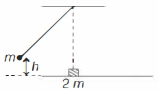
A ball of mass $m$ suspended from a rigid support by an inextensible massless string is released from a height $h$ above its lowest point. At its lowest point, it collides elastically with a block of mass $2 m$ at rest on a frictionless surface. Neglect the dimensions of the ball and the block. After the collision, the ball rises to a maximum height of
A ball hits a floor and rebounds after an inelastic collision. In this case:
A bomb of mass $9 \,kg$ explodes into two pieces of masses $3 \,kg$ and $6 \,kg$. The velocity of mass $3 \,kg$ is $16 \,m / s$. The kinetic energy of mass $6 \,kg$ in joule is
A bomb of mass $m$ is projected from the ground with speed $v$ at angle $\theta$ with the horizontal. At the maximum height from the ground it explodes into two fragments of equal mass. If one fragment comes to rest immediately after explosion, then the horizontal range of centre of mass is ..............
A projectile can have the same range $R$ for two angles of projection. If $t_1$ and $t_2$ be the times of flights in the two cases, then the product of the two time of flights is proportional to
If the liquid in a U-tube of cross-section A rises to a height $h$. Then the period of oscillatory motion of the fluid is T. Liquid in a U-tube of cross section $\frac{A}{2}$ If you fill up to the height and make it oscillate then the time period will be :
A particle moves in a plane with constant acceleration in a direction different from the initial velocity. The path of the particle will be
Consider the following two statements: $(A)$ The linear momentum of a particle is independent of the frame of reference. $(B)$ The kinetic energy of a particle is independent of the frame of reference.
A gas is compressed from a volume of $2\,m^3$ to a volume of $1\, m^3$ at a constant pressure of $100\, N/m^2$. Then it is heated at constant volume by supplying $150\, J$ of energy. As a result, the internal energy of the gas
Two thin metallic spherical shells of radii ${r}_{1}$ and ${r}_{2}$ $\left({r}_{1}<{r}_{2}\right)$ are placed with their centres coinciding. A material of thermal conductivity ${K}$ is filled in the space between the shells. The inner shell is maintained at temperature $\theta_{1}$ and the outer shell at temperature $\theta_{2}\left(\theta_{1}<\theta_{2}\right)$. The rate at which heat flows radially through the material is :-