The apparent frequency of a sound wave as heard by an observer is $10\%$ more than the actual frequency. If the velocity of sound in air is $330\,m/sec$ , then
$(i)$ The source may be moving towards the observer with a velocity of $30\,ms^{-1}$
$(ii)$ The source may be moving towards the observer with a velocity of $33\,ms^{-1}$
$(iii)$ The observer may be moving towards the source with a velocity of $30\,ms^{-1}$
$(iv)$ The observer may be moving towards the source with a velocity of $33\,ms^{-1}$
Diffcult
Download our app for free and get started
$f_{\mathrm{app}}=f_{\mathrm{actual}}+10 \%$ of factual
$=\mathrm{f}+\frac{10}{100} \mathrm{f}=1.1 \mathrm{f}=\mathrm{f}\left[\frac{\mathrm{v}-\mathrm{v}_{0}}{\mathrm{v}-\mathrm{v}_{\mathrm{s}}}\right]$
$\Rightarrow \frac{v-v_{0}}{v-v_{s}}=1.1$
if $v_{0}=0 \Rightarrow v=1.1 \mathrm{v}-1.1 \mathrm{v}_{\mathrm{s}}$
$\Rightarrow v_{s}=\frac{0.1 \mathrm{v}}{1.1}=\frac{330}{11}=30 \mathrm{\,m} / \mathrm{sec}$
$\mathrm{v}_{\mathrm{s}}=30 \mathrm{\,m} / \mathrm{s}$
[source moving towards stationary observer]
Case $II \,:$ $v_{s}=0$
$\Rightarrow 1.1=\left[\frac{\mathrm{v}-\mathrm{v}_{0}}{\mathrm{v}}\right]$
$\Rightarrow 1.1 \mathrm{v}=\mathrm{v}-\mathrm{v}_{0}$
$\Rightarrow \mathrm{v}_{0}=-0.1 \mathrm{v}$
$\mathrm{v}_{0}=-33 \mathrm{\,m} / \mathrm{sec}$
(observer moving towards source)

Download our appand get started for free
Experience the future of education. Simply download our apps or reach out to us for more information. Let's shape the future of learning together!No signup needed.*
Similar Questions
- 1A source of sound is moving with constant velocity of $20\, m/s$ emitting a note of frequency $1000 \,Hz.$ The ratio of frequencies observed by a stationary observer while the source is approaching him and after it crosses him will beView Solution
(Speed of sound $v = 340\, m/s$)
- 2View SolutionIn a stretched string,
- 3The velocity of waves in a string fixed at both ends is $2 m/s$. The string forms standing waves with nodes $5.0 cm$ apart. The frequency of vibration of the string in $Hz$ isView Solution
- 4Velocity of sound waves in air is $330\; m/sec$. For a particular sound in air, a path difference of $40 \;cm$ is equivalent to a phase difference of $1.6 \pi$. The frequency of this wave is... $Hz$View Solution
- 5View SolutionWhen an aeroplane attains a speed higher than the velocity of sound in air, a loud bang is heard. This is because
- 6View SolutionWhen temperature increases, the frequency of a tuning fork
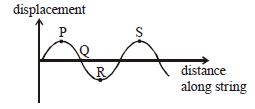
- 7The given graph illustrates a transverse wave travelling on a string at a particular instant, and the points $P, Q, R$ and $S$ represent elements of the string. Which of the following statements about the motion of the elements is correct?View Solution
- 8Two sources of sound $A$ and $B$ produces the wave of $350 Hz$, they vibrate in the same phase. The particle $P$ is vibrating under the influence of these two waves, if the amplitudes at the point $P$ produced by the two waves is $0.3 mm$ and $0.4 mm,$ then the resultant amplitude of the point $P$ will be when $AP -BP = 25 cm$ and the velocity of sound is $350 m/sec$ .... $mm$View Solution
- 9View SolutionThe note"Saa" on the Sarod and the Sitar have the same pitch. The property of sound that is most important in distinguishing between the two instruments is
- 10Two travelling waves produces a standing wave represented by equation,View Solution
${y}=1.0\, {mm} \cos \left(1.57 \,{cm}^{-1}\right) {x} \sin \left(78.5\, {s}^{-1}\right) {t}$
The node closest to the origin in the region ${x}>0$ will be at ${x}=\ldots \ldots \ldots\, {cm}$