The area of cross-section of a wire of length $1.1$ metre is $1$ $mm^2$. It is loaded with $1 \,kg.$ If Young's modulus of copper is $1.1 \times {10^{11}}\,N/{m^2}$, then the increase in length will be ......... $mm$ (If $g = 10\,m/{s^2})$
Medium


Download our appand get started for free
Experience the future of education. Simply download our apps or reach out to us for more information. Let's shape the future of learning together!No signup needed.*
Similar Questions
- 1View SolutionThe Bulk modulus for an incompressible liquid is
- 2When a certain weight is suspended from a long uniform wire, its length increases by one $cm$. If the same weight is suspended from another wire of the same material and length but having a diameter half of the first one, the increase in length will be ......... $cm$View Solution
- 3A steel wire of diameter $0.5 mm$ and Young's modulus $2 \times 10^{11} N m ^{-2}$ carries a load of mass $M$. The length of the wire with the load is $1.0 m$. A vernier scale with $10$ divisions is attached to the end of this wire. Next to the steel wire is a reference wire to which a main scale, of least count $1.0 mm$, is attached. The $10$ divisions of the vernier scale correspond to $9$ divisions of the main scale. Initially, the zero of vernier scale coincides with the zero of main scale. If the load on the steel wire is increased by $1.2 kg$, the vernier scale division which coincides with a main scale division is. . . . Take $g =10 m s ^{-2}$ and $\pi=3.2$.View Solution
- 4A copper wire of length $4.0m$ and area of cross-section $1.2\,c{m^2}$ is stretched with a force of $4.8 \times {10^3}$ $N.$ If Young’s modulus for copper is $1.2 \times {10^{11}}\,N/{m^2},$ the increase in the length of the wire will beView Solution
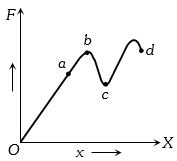
- 5The graph is drawn between the applied force $F$ and the strain $(x)$ for a thin uniform wire. The wire behaves as a liquid in the partView Solution
- 6A string of area of cross-section $4\,mm ^{2}$ and length $0.5$ is connected with a rigid body of mass $2\,kg$. The body is rotated in a vertical circular path of radius $0.5\,m$. The body acquires a speed of $5\,m / s$ at the bottom of the circular path. Strain produced in the string when the body is at the bottom of the circle is $\ldots . . \times 10^{-5}$. (Use Young's modulus $10^{11}\,N / m ^{2}$ and $g =10\,m / s ^{2}$ )View Solution
- 7The relation between $\gamma ,\,\eta $ and $K$ for a elastic material isView Solution
- 8A $2 \,m$ long rod of radius $1 \,cm$ which is fixed from one end is given a twist of $0.8$ radians. The shear strain developed will beView Solution
- 9Steel and copper wires of same length are stretched by the same weight one after the other. Young's modulus of steel and copper are $2 \times {10^{11}}\,N/{m^2}$ and $1.2 \times {10^{11}}\,N/{m^2}$. The ratio of increase in lengthView Solution
- 10The density and breaking stress of a wire are $6 \times$ $10^4 \mathrm{~kg} / \mathrm{m}^3$ and $1.2 \times 10^8 \mathrm{~N} / \mathrm{m}^2$ respectively. The wire is suspended from a rigid support on a planet where acceleration due to gravity is $\frac{1^{\text {rd }}}{3}$ of the value on the surface of earth. The maximum length of the wire with breaking is ............ $\mathrm{m}$ (take, $\mathrm{g}=$ $\left.10 \mathrm{~m} / \mathrm{s}^2\right)$View Solution