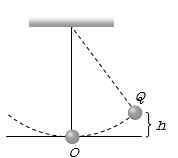
The bob of a simple pendulum is displaced from its equilibrium position $O$ to a position $Q$ which is at height h above $O$ and the bob is then released. Assuming the mass of the bob to be $m$ and time period of oscillations to be $2.0\, sec$, the tension in the string when the bob passes through $O$ is
Diffcult
Download our app for free and get started
(a) Tension in the string when bob passes through lowest point
$T = mg + \frac{{m{v^2}}}{r} = mg + mv\omega $ ( $v = r\omega$)
putting $v = \sqrt {2gh} $ and $\omega= \frac{{2\pi }}{T} = \frac{{2\pi }}{2} = \pi $
we get $T = m\;(g + \pi \sqrt {2gh} )$

Download our appand get started for free
Experience the future of education. Simply download our apps or reach out to us for more information. Let's shape the future of learning together!No signup needed.*
Similar Questions
- 1The potential energy of a simple harmonic oscillator when the particle is half way to its end point is (where $E$ is the total energy)View Solution
- 2View SolutionA system exhibiting S.H.M. must possess
- 3A force of $6.4\ N$ stretches a vertical spring by $0.1\ m$. The mass that must be suspended from the spring so that it oscillates with a time period of $\pi/4\ second$ is .... $kg$View Solution
- 4The amplitude of a wave represented by displacement equationView Solution
$y = \frac{1}{{\sqrt a }}\,\sin \,\omega t \pm \frac{1}{{\sqrt b }}\,\cos \,\omega t$ will be
- 5Two bodies $M$ and $N $ of equal masses are suspended from two separate massless springs of force constants $k_1$ and $k_2$ respectively. If the two bodies oscillate vertically such that their maximum velocities are equal, the ratio of the amplitude $M$ to that of $N$ isView Solution
- 6The displacement time equation of a particle executing $SHM$ is : $x = A \,sin\,(\omega t + \phi )$. At time $t = 0$ position of the particle is $x = A/2$ and it is moving along negative $x-$ direction. Then the angle $\phi $ can beView Solution
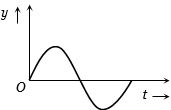
- 7The displacement time graph of a particle executing $S.H.M.$ is as shown in the figureThe corresponding force-time graph of the particle isView Solution
- 8A particle is executing $S.H.M.$ with total mechanical energy $90 \,J$ and amplitude $6 \,cm$. If its energy is somehow decreased to $40 \,J$ then its amplitude will become ........ $cm$View Solution
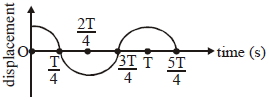
- 9The displacement time graph of a particle executing $S.H.M.$ is given in figure: (sketch is schematic and not to scale) Which of the following statements is are true for this motion?View Solution
$(A)$ The force is zero $t=\frac{3 T}{4}$
$(B)$ The acceleration is maximum at $t=T$
$(C)$ The speed is maximum at $t =\frac{ T }{4}$
$(D)$ The $P.E.$ is equal to $K.E.$ of the oscillation at $t=\frac{T}{2}$
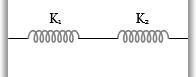
- 10View SolutionThe effective spring constant of two spring system as shown in figure will be