The bob of a simple pendulum of mass m and total energy $E$ will have maximum linear momentum equal to
Easy


Download our appand get started for free
Experience the future of education. Simply download our apps or reach out to us for more information. Let's shape the future of learning together!No signup needed.*
Similar Questions
- 1Two particle executing $S.H.M.$ of same amplitude of $20 \,cm$ with same period along the same line about same equilibrium position. The maximum distance between the two is $20 \,cm$. Their phase difference in radian is equal toView Solution
- 2A simple pendulum executing $S.H.M.$ is falling freely along with the support. ThenView Solution
- 3The motion of a simple pendulum excuting $S.H.M$. is represented by following equation.View Solution
$Y = A \sin (\pi t +\phi)$, where time is measured in $second$.
The length of pendulum is .............$cm$
- 4The ratio of maximum acceleration to maximum velocity in a simple harmonic motion is $10\,s^{-1}$. At, $t = 0$ the displacement is $5\, m$. What is the maximum acceleration ? The initial phase is $\frac{\pi }{4}$View Solution
- 5The total energy of a particle executing $S.H.M.$ is $80 \,J$. What is the potential energy when the particle is at a distance of $\frac{3}{4}$ of amplitude from the mean position..... $J$View Solution
- 6The kinetic energy and potential energy of a particle executing simple harmonic motion will be equal, when displacement (amplitude = $a$) isView Solution
- 7A $ U$ tube of uniform bore of cross-sectional area $A$ has been set up vertically with open ends facing up. Now $m$ gm of a liquid of density $d$ is poured into it. The column of liquid in this tube will oscillate with a period $T$ such thatView Solution
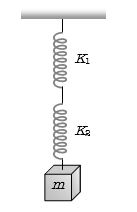
- 8View SolutionThe frequency of oscillation of the springs shown in the figure will be
- 9A body of mass $1\,kg$ is executing simple harmonic motion. Its displacement $y(cm)$ at $t$ seconds is given by $y = 6\sin (100t + \pi /4)$. Its maximum kinetic energy is ..... $J$View Solution
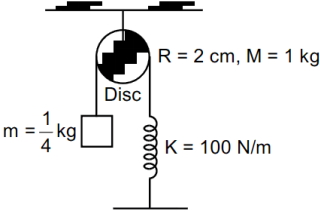
- 10View SolutionFor the system given below, find the angular frequency of oscillation ?