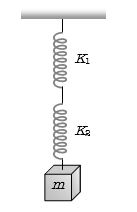
The frequency of oscillation of the springs shown in the figure will be
AIIMS 2001, Medium
Download our app for free and get started
(d)$n = \frac{1}{{2\pi }}\sqrt {\frac{{{k_{eq}}}}{m}} = \frac{1}{{2\pi }}\sqrt {\frac{{{k_1}{k_2}}}{{({k_1} + {k_2})m}}} $

Download our appand get started for free
Experience the future of education. Simply download our apps or reach out to us for more information. Let's shape the future of learning together!No signup needed.*
Similar Questions
- 1A uniform spring of force constant $k$ is cut into two pieces, the lengths of which are in the ratio $1 : 2$. The ratio of the force constants of the shorter and the longer pieces isView Solution
- 2An object of mass $0.5\, {kg}$ is executing simple harmonic motion. Its amplitude is $5\, {cm}$ and time period (T) is $0.2\, {s} .$ What will be the potential energy of the object at an instant $t=\frac{T}{4}$ s starting from mean position. Assume that the initial phase of the oscillation is zero. (In ${J}$)View Solution
- 3View SolutionTime period of pendulum, on a satellite orbiting the earth, is
- 4$Assertion :$ The time-period of pendulum, on a satellite orbiting the earth is infinity.View Solution
$Reason :$ Time-period of a pendulum is inversely proportional to $\sqrt g$ - 5View SolutionIn forced oscillations, a particle oscillates simple harmonically with frequency equal to
- 6A particle executes simple harmonic motion with an amplitude of $4 \mathrm{~cm}$. At the mean position, velocity of the particle is $10 \mathrm{~cm} / \mathrm{s}$. The distance of the particle from the mean position when its speed becomes $5 \mathrm{~cm} / \mathrm{s}$ is $\sqrt{\alpha} \mathrm{cm}$, where $\alpha=$____________.View Solution
- 7A $1 \,kg$ block attached to a spring vibrates with a frequency of $1\, Hz$ on a frictionless horizontal table. Two springs identical to the original spring are attached in parallel to an $8\, kg$ block placed on the same table. So, the frequency of vibration of the $8\, kg$ block is ..... $Hz$View Solution
- 8If two similar springs each of spring constant $K _{1}$ are joined in series, the new spring constant and time period would be changed by a factorView Solution
- 9A linear harmonic oscillator of force constant $2 \times {10^6}N/m$ and amplitude $0.01\, m$ has a total mechanical energy of $160$ joules. ItsView Solution
- 10View SolutionIn the adjacent figure, if the incline plane is smooth and the springs are identical, then the period of oscillation of this body is