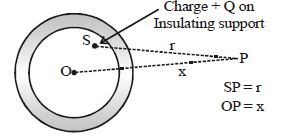
The adjacent diagram shows a charge $+Q$ held on an insulating support $S$ and enclosed by a hollow spherical conductor. $O$ represents the centre of the spherical conductor. and $P$ is a point such that $OP = x $ and $SP = r$ . The electric field at point $P$ will be
Medium


Download our appand get started for free
Experience the future of education. Simply download our apps or reach out to us for more information. Let's shape the future of learning together!No signup needed.*
Similar Questions
- 1If $50$ joule of work must be done to move an electric charge of $2 \,C$ from a point, where potential is $-10$ volt to another point, where potential is $V$ volt, the value of $V$ is ......... $V$View Solution
- 2View SolutionInside a hollow charged spherical conductor, the potential
- 3The potential at a distance $R/2$ from the centre of a conducting sphere of radius $ R$ will beView Solution
- 4In an hydrogen atom, the electron revolves around the nucleus in an orbit of radius $0.53 \times {10^{ - 10}}\,m$. Then the electrical potential produced by the nucleus at the position of the electron is......$V$View Solution
- 5A parallel plate capacitor Air filled with a dielectric whose dielectric constant varies with applied voltage as $K = V$. An identical capacitor $B$ of capacitance $C_0$ with air as dielectric is connected to voltage source $V_0 = 30\,V$ and then connected to the first capacitor after disconnecting the voltage source. The charge and voltage on capacitor.View Solution
- 6View SolutionWhen one electron is taken towards the other electron, then the electric potential energy of the system
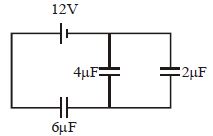
- 7The charge deposited on $4\,\mu F$ capacitor in the circuit isView Solution
- 8A particle of mass $m$ and charge $q$ is kept at the top of a fixed frictionless sphere. $A$ uniform horizontal electric field $E$ is switched on. The particle looses contact with the sphere, when the line joining the center of the sphere and the particle makes an angle $45^o$ with the vertical. The ratio $\frac{qE}{mg}$ is :-View Solution
- 9Four identical charges $ + \,50\,\mu C$ each are placed, one at each corner of a square of side $2\,m$. How much external energy is required to bring another charge of $ + \,50\,\mu C$ from infinity to the centre of the square......$J$ $\left( {{\rm{Given}}\frac{{\rm{1}}}{{{\rm{4}}\pi {\varepsilon _{\rm{0}}}}} = 9 \times {{10}^9}\,\frac{{N{m^2}}}{{{C^2}}}} \right)$View Solution
- 10A pellet carrying charge of $0.5\, coulombs$ is accelerated through a potential of $2,000\, volts$. It attains a kinetic energy equal toView Solution