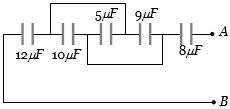
What is the potential difference between $A$ and $B$ in the circuit shown.......$V$
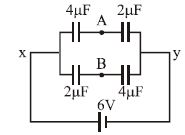
Medium


Download our appand get started for free
Experience the future of education. Simply download our apps or reach out to us for more information. Let's shape the future of learning together!No signup needed.*
Similar Questions
- 1The electric potential at a point $(x, y, z)$ is given by $V=-x^2y-xz^3 +4 $. The electric field at that point isView Solution
- 2Separation between the plates of a parallel plate capacitor is $d$ and the area of each plate is $A$. When a slab of material of dielectric constant $k$ and thickness $t(t < d)$ is introduced between the plates, its capacitance becomesView Solution
- 3Two capacitors of capacities $2 {C}$ and ${C}$ are joined in parallel and charged up to potential ${V}$. The battery is removed and the capacitor of capacity $C$ is filled completely with a medium of dielectric constant ${K}$. The potential difference across the capacitors will now beView Solution
- 4A parallel plate capacitor has plate of length $'l',$ width $'w'$ and separation of plates is $'d'.$ It is connected to a battery of emf $V$. A dielectric slab of the same thickness '$d$' and of dielectric constant $k =4$ is being inserted between the plates of the capacitor. At what length of the slab inside plates, will be energy stored in the capacitor be two times the initial energy stored$?$View Solution
- 5An electric charge $10^{-6} \mu \mathrm{C}$ is placed at origin $(0,0)$ $\mathrm{m}$ of $\mathrm{X}-\mathrm{Y}$ co-ordinate system. Two points $\mathrm{P}$ and $\mathrm{Q}$ are situated at $(\sqrt{3}, \sqrt{3}) \mathrm{m}$ and $(\sqrt{6}, 0) \mathrm{m}$ respectively. The potential difference between the points $P$ and $Q$ will be :View Solution
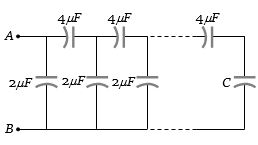
- 6A finite ladder is constructed by connecting several sections of $2\,\mu F,\;4\,\mu F$ capacitor combinations as shown in the figure. It is terminated by a capacitor of capacitance $C$. What value should be chosen for $C$ such that the equivalent capacitance of the ladder between the points $A$ and $B$ becomes independent of the number of sections in between......$\mu F$View Solution
- 7In one design of capacitor thin sheets ot metal of area $80\ mm \times 80\ mm$ sandwich between them a piece of paper whose thickness is $40\ μm$. The relative permittivity of the paper is $4.0$ and its dielectric strength is $20\ MVm^{-1}$. Calculate the maximum charge that can be put on the capacitorView Solution
[permittivity of free space $ = 9 \times 10^{-12}\ Fm^{-1}$]
- 8If charge on each plate of a parallel plate capacitor is $Q$ and the magnitude of electric field between the plates is $E$ then force on each plate of a parallel plate capacitor will beView Solution
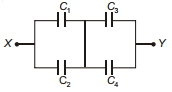
- 9In the circuit shown below $C_1=10 \,\mu F , C_2=C_3=20 \,\mu F$, and $C_4=40 \,\mu F$. If the charge on $C_1$ is $20 \,\mu C$ then potential difference between $X$ and $Y$ is ......... $V$View Solution
- 10The capacities and connection of five capacitors are shown in the adjoining figure. The potential difference between the points $A$ and $B$ is $60\;volts$. Then the equivalent capacity between $A$ and $B$ and the charge on $5\,\mu F$ capacitance will be respectivelyView Solution