The capacity of a parallel plate condenser depends on
Easy
Download our app for free and get started
$C = \frac{{{ \in _0}A}}{d}$

Download our appand get started for free
Experience the future of education. Simply download our apps or reach out to us for more information. Let's shape the future of learning together!No signup needed.*
Similar Questions
- 1A particle $A$ has charge $+q$ and particle $B$ has charge $+4 q$ with each of them having the same mass $m$. When allowed to fall from rest through the same electric potential difference, the ratio of their speeds $\frac{V_A}{V_B}$ will becomeView Solution
- 2If the capacity of a spherical conductor is $1$ picofarad, then its diameter, would beView Solution
- 3If $n$ drops, each of capacitance $C$, coalesce to form a single big drop, then the ratio of the energy stored in the big drop to that in each small drop will beView Solution
- 4The capacity of a condenser is $4 \times {10^{ - 6}}$ farad and its potential is $100\,\,volts$. The energy released on discharging it fully will be.......$Joule$View Solution
- 5A capacitor is charged with a battery and energy stored is $U$. After disconnecting battery another capacitor of same capacity is connected in parallel to the first capacitor. Then energy stored in each capacitor isView Solution
- 6The potential at a point $x$ (measured in $μ\ m$) due to some charges situated on the $ x$-axis is given by $V(x)$ =$\frac{{20}}{{{x^2} - 4}}$ $volt$ The electric field $E$ at $x = 4\ μ m$ is given byView Solution
- 7Two charges of $4\,\mu C$ each are placed at the corners $A$ and $B $ of an equilateral triangle of side length $0.2\, m $ in air. The electric potential at $C$ is $\left[ {\frac{1}{{4\pi {\varepsilon _0}}} = 9 \times {{10}^9}\,\frac{{N{\rm{ - }}{m^2}}}{{{C^2}}}} \right]$View Solution
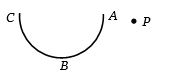
- 8In the following diagram the work done in moving a point charge from point $P$ to point $A$, $B$ and $C$ is respectively as $W_A$, $W_B$ and $W_C$ , thenView Solution
- 9Three capacitors of $2.0,\;3.0$ and $6.0\;\mu F$ are connected in series to a $10\,V$ source. The charge on the $3.0\,\mu F$ capacitor is........$\mu C$View Solution
- 10The electric potential at a distance of $3 \,m$ on the axis of a short dipole of dipole moment $4 \times 10^{-12}$ coulomb-meter is ......... $mV$View Solution