The coefficient of static friction between a wooden block of mass $0.5\, kg$ and a vertical rough wall is $0.2$ The magnitude of horizontal force that should be applied on the block to keep it adhere to the wall will be $N$ $\left[ g =10\, ms ^{-2}\right]$
JEE MAIN 2021, Medium



Download our appand get started for free
Experience the future of education. Simply download our apps or reach out to us for more information. Let's shape the future of learning together!No signup needed.*
Similar Questions
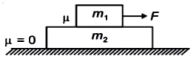
- 1In the given arrangement the maximum value of $F$ for which there is no relative motion between the blocksView Solution
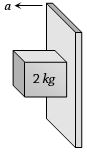
- 2A rough vertical board has an acceleration $‘a’$ so that a $2$ kg block pressing against it does not fall. The coefficient of friction between the block and the board should beView Solution
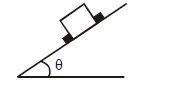
- 3A railway line is taken round a circular arc of radius $1000\ m$, and is banked by raising the outer rail $h\ m$ above the inner rail. If the lateral force on the inner rail when a train travels round the curve at $10 \ ms^{-1}$ is equal to the lateral force on the outer rail when the train's speed is $20\ ms^{-1}$. The value of $4g\ tan\theta$ is equal to : (The distance between the rails is $1.5 \ m$).View Solution
- 4A motorcycle is going on an overbridge of radius $R$. The driver maintains a constant speed. As the motorcycle is ascending on the overbridge, the normal forces on it isView Solution
- 5A $100 \,kg$ car is moving with a maximum velocity of $9 \,m/s$ across a circular track of radius $30\,m$. The maximum force of friction between the road and the car is ........ $N$View Solution
- 6A cyclist on a level road takes a sharp circular turn of radius $3 \;m \;\left( g =10 \;ms ^{-2}\right)$. If the coefficient of static friction between the cycle tyres and the road is $0.2$, at which of the following speeds will the cyclist not skid while taking the turn?View Solution
- 7A body is sliding down an inclined plane (angle of inclination $45^o$). If the coefficient of friction is $0.5$ and $g = 9.8\, m/s^2$. then the acceleration of the body downwards in $m/s^2$ isView Solution
- 8A car of mass $1000\, kg$ negotiates a banked curve of radius $90\, m$ on a frictionless road. If the banking angle is $45^o $, the speed of the car is ....... $ms^{-1}$View Solution
- 9Statement $I :$ A cyclist is moving on an unbanked road with a speed of $7\, kmh ^{-1}$ and takes a sharp circular turn along a path of radius of $2 \,m$ without reducing the speed. The static friction coefficient is $0.2$ . The cyclist will not slip and pass the curve $\left( g =9.8\, m / s ^{2}\right)$View Solution
Statement $II :$ If the road is banked at an angle of $45^{\circ}$, cyclist can cross the curve of $2\, m$ radius with the speed of $18.5\, kmh ^{-1}$ without slipping.
In the light of the above statements, choose the correct answer from the options given below.
- 10A stone of mass of $16\, kg$ is attached to a string $144 \,m$ long and is whirled in a horizontal circle. The maximum tension the string can withstand is $16$ Newton. The maximum velocity of revolution that can be given to the stone without breaking it, will be ....... $ms^{-1}$View Solution