MCQ
The component of a vector r along X-axis will have maximum value if
- Ar is along positive Y-axis.
- Br is along positive X-axis.
- Cr makes an angle of 45° with the X-axis.
- Dr is along negative Y-axis.
Explanation:
Consider a vector $\vec{\text{R}}$ in X-Y plane as shown in figure. If we draw orthogonal vectors $\vec{\text{R}}_{\text{x}}$ and $\vec{\text{R}}_{\text{y}}$ along x and y axes respectively, by law of vector addition, $\vec{\text{R}}=\vec{\text{R}}_{\text{x}}+\vec{\text{R}}_{\text{y}}$
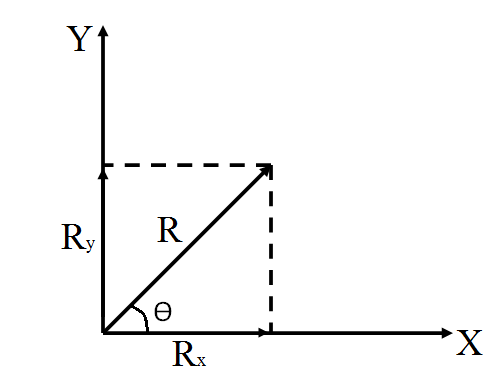
The magnitude of component of r along X-axis
$\text{r}_\text{x}=|\text{r}|\cos\theta$
$(\text{r}_\text{x})_{\text{maximum}}=|\text{r}|(\cos\theta)_{\text{maximum}}$
$\text{r}_\text{x}=|\text{r}|\cos\theta$
$=|\text{r}|\cos0^\circ=|\text{r}|$ $(\because\cos\theta$ is maximum if $\theta=0^\circ)$
As $\theta=0^\circ,$
r is along positive x-axis.
Generate a complete, print-ready paper with questions like this in minutes — across 16+ boards, with answer keys.
$\text{h}$
$\frac{\text{h}}{2}$
$\frac{\text{h}}{2\pi}$
$\frac{\text{h}}{\lambda}$
(Molecular weight of oxygen is $32 \,g / mol$ $\left. R =8.3 \,J K ^{-1} mol ^{-1}\right)$
$\text{x}=\text{A}\sin(\text{ky}-\omega\text{t})$
$\text{y}=\text{A}\sin(\text{kx}-\omega\text{t})$
$\text{y}=\text{A}\sin\text{ky}\cos\ \omega\text{t}$
$\text{y}=\text{A}\cos\text{ky}\sin\ \omega\text{t}.$