Question
The conductivity of an intrinsic samiconductor depends on temperature as $\sigma=\sigma_0\text{ e}^{\frac{-\Delta\text{E}}{2\text{kT}}}$ where $\sigma_0$ is a constant. Find the temperature at which the conductivity pf an intrinsic germanium semiconductor will be double of its value at T = 300K. Assume that the gap for germanium is 0.650eV and remains constant as the temperature is increased.
Answer

$\sigma=\sigma_0\text{e}^{\frac{-\Delta\text{E}}{2\text{KT}}}$
$\Delta\text{E}=0.650\text{eV},\text{T}=300\text{K}$
According to question, $\text{K}=8.62\times10^{-5}\text{eV}$
$\sigma_0\text{e}^{\frac{-\Delta\text{E}}{2\text{KT}}}=2\times\sigma_0\text{e}^{\frac{-\Delta\text{E}}{2\times\text{K}\times300}}$
$\Rightarrow\text{e}^{\frac{-0.65}{2\times8.62\times10^{-5}\times\text{T}}}=6.96561\times10^{-5}$
Taking in on both sides,
We get, $\frac{-0.65}{2\times8.62\times10^{-5}\times\text{T}'}=-11.874525$
$\rightarrow\frac{1}{\text{T}'}=\frac{11.574525\times2\times8.62\times10^{-5}}{0.65}$
$\Rightarrow\text{T}'=317.51178=318\text{K}.$

Need a full question paper?

Generate a complete, print-ready paper with questions like this in minutes — across 16+ boards, with answer keys.

Start Generating Free

Similar questions

Show that for a material with refractive index $\mu\geq\sqrt{2}$, light incident at any angle shall be guided along a length perpendicular to the incident face.
Find the wavelength of the radiation emitted by hydrogen in the transitions $(a) n = 3$ to $n= 2, (b) n = 5$ to $n = 4$ and $(c) n = 10$ to $n = 9.$
Use (i) the Ampere's law for H and (ii) continuity of lines of B, to conclude that inside a bar magnet, (a) lines of H run from the N pole to S pole, while (b) lines of B must run from the S pole to N pole.
Consider a system of $n$ charges $q_1, q_2, ... q_n$ with position vectors $\vec{\text{r}}_1,\vec{\text{r}}_2,\vec{\text{r}}_3,...\vec{\text{r}}_\text{n}$ relative to some origin $'O\ ’$. Deduce the expression for the net electric field $\vec{\text{E}}$ at a point $P$ with position vector $\vec{\text{r}}_\text{p},$ due to this system of charges.
A hole of radius $r_1$ is made centrally in a uniform circular disc of thickness $d$ and radius $r_2.$ The inner surface $($a cylinder of length $d$ and radius $r_1)$ is maintained at a temperature $\theta_1$ and the outer surface $($a cylinder of length $d$ and radius $r_2)$ is maintained at a temperature $\theta_2(\theta_1>\theta_2).$ The thermal conductivity of the material of the disc is $K.$ Calculate the heat flowing per unit time through the disc.
Repeat the previous problem if the particle C is displaced through a distance x along the line AB.
A particle of mass $1g$ and charge $2.5 \times 10^{-4}C$ is released from rest in an electric field of $1.2 \times 10^4NC^{-1}.$
  1. Find the electric force and the force of gravity acting on this particle. Can one of these forces be neglected in comparison with the other for approximate analysis?
  2. How long will it take for the particle to travel a distance of $40\ cm?$
  3. What will be the speed of the particle after travelling this distance?
  4. How much is the work done by the electric force on the particle during this period?
​​​​​​​
Two charges $2.0 \times 10^{-6}C$ and $1.0 \times 10^{-6}C$ are placed at a separation of $10\ cm$. Where should a third charge be placed such that it experiences no net force due to these charges?
A $100$ turn closely wound circular coil of radius $10 \ cm$ carries a current of $3.2 A. \ (a)$ What is the field at the centre of the coil? $(b)$ What is the magnetic moment of this coil?
The coil is placed in a vertical plane and is free to rotate about a horizontal axis which coincides with its diameter. A uniform magnetic field of $2 T$ in the horizontal direction exists such that initially the axis of the coil is in the direction of the field. The coil rotates through an angle of $90^{\circ}$ under the influence of the magnetic field. $(c)$ What are the magnitudes of the torques on the coil in the initial and final position?
$(d)$ What is the angular speed acquired by the coil when it has rotated by $90^{\circ}$ ? The moment of inertia of the coil is $0.1 \ kg m ^2$.
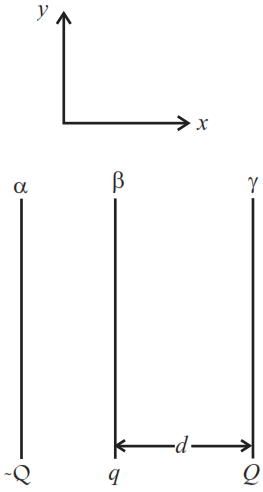
Two fixed, identical conducting plates $(\alpha\ \ \ \beta)$, each of surface area $S$ are charged to $-Q$ and $q,$ respectively, where $Q > q > 0.$ A third identical plate $(\gamma)$, free to move is located on the other side of the plate with charge $q$ at $a$ distance $d ($Fig$).$ The third plate is released and collides with the plate $\beta$. Assume the collision is elastic and the time of collision is sufficient to redistribute charge amongst $\beta\ \ \ \gamma$.

Find the charges on $\beta$ and $\gamma$ after the collision.