Question
The count rate from a radioactive sample falls from $4.0 \times 10^6$ per second to $1.0 \times 10^6$ per second in 20 hours. What will be the count rate 100 hours after the beginning?

Answer

$\text{A}_0=4\times10^5$ disintegration/sec$\text{A}'=1\times10^6$ dis/sec; t = 20 hours.
$\text{A}'=\frac{\text{A}_0}{2^{\frac{\text{t}}{\text{t}_{\frac{1}{2}}}}}\Rightarrow2^{\frac{\text{t}}{\text{t}_{\frac{1}{2}}}}=\frac{\text{A}_0}{\text{A}'}\Rightarrow2^{\frac{\text{t}}{\text{t}_{\frac{1}{2}}}}=4$
$\Rightarrow\frac{\text{t}}{\text{t}_{\frac{1}{2}}}=2\Rightarrow\text{t}^{\frac{1}{2}}=\frac{\text{t}}{2}=\frac{20\text{ hours}}{2}=10\text{ hours}.$
$\text{A}''=\frac{\text{A}_0}{2^{\frac{\text{t}}{\text{t}_{\frac{1}{2}}}}}\Rightarrow\text{A}''=\frac{4\times10^6}{2^{\frac{100}{10}}}$
$=0.00390625\times10^6=3.9\times10^3$ dintegrations/sec.

Need a full question paper?

Generate a complete, print-ready paper with questions like this in minutes — across 16+ boards, with answer keys.
Start Generating Free

Similar questions

Explain barrier potential of $p-n$ junction.
One end of a cylindrical glass rod $(\mu=1.5)$ of radius 1.0cm is rounded in the shape of a hemisphere. The rod is immersed in water $\Big(\mu=\frac{4}{3}\Big)$ and an object is placed in the water along the axis of the rod at a distance of 8.0cm from the rounded edge. Locate the image of the object.
Radioactive isotopes are produced in a nuclear physics experiment at a constant rate $\frac{\text{dN}}{\text{dt}}=\text{R}.$ An inductor of inductance 100mH, a resistor of resistance $100\Omega$ and a battery are connected to form a series circuit. The circuit is switched on at the instant the production of radioactive isotope starts. It is found that $\frac{\text{i}}{\text{N}}$ remains constant in time where i is the current in the circuit at time t and N is the number of active nuclei at time t. Find the half-life of the isotope.
In a Young’s double-slit experiment, the slits are separated by 0.28 mm and the screen is placed 1.4 m away. The distance between the central bright fringe and the fourth bright fringe is measured to be 1.2 cm. Determine the wavelength of light used in the experiment.
Two heater coils made of same material are connected in parallel across the mains. The length and diameter of the wire of one of coils are double that of the other. Which one of them will produce more heat?
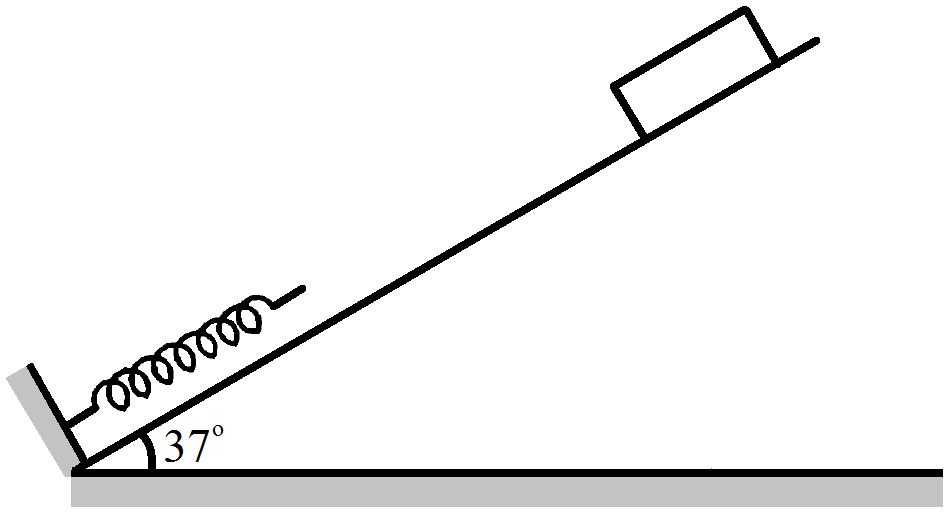
Figure shows a spring fixed at the bottom end of an incline of inclination 37°. A small block of mass 2kg starts slipping down the incline from a point 4.8m away from the spring. The block compresses the spring by 20cm, stops momentarily and then rebounds through a distance of 1m up the incline. Find.
  1. The friction coefficient between the plane and the block.
  2. The spring constant of the spring. Take $g = 10m/s^2.$
  1. State two important features of Einstein's photoelectric equation.
  2. Radiation of frequency $10^{15}\ Hz$ is incident on two photosensitive surface P and Q. There is no photoemission from surface P. Photoemission occurs from surface Q but photoelectrons have zero kinetic energy. Explain these observations and find the value of work function for surface Q.
Arrange electromagnetic radiations in the ascending order of their frequencies. Write uses of any one of them-Micro waves, Radio waves, X-rays, gamma rays.
A steel wire of original length 1m and cross-sectional area $4.00mm^2$ is clamped at the two ends so that it lies horizontally and without tension. If a load of 2.16kg is suspended from the middle point of the wire, what would be its vertical depression? Y of the steel $= 2.0 \times 10^{11}N/m^2$ Take $g = 10m/s^2.$
A source emitting a sound of frequency v is placed at a large distance from an observer. The source starts moving towards the observer with a uniform acceleration a. Find the frequency heard by the observer corresponding to the wave emitted just after the source starts. The speed of sound in the medium is u.