When the switch $S$, in the circuit shown, is closed, then the value of current $i$ will be ................. $A$
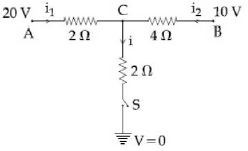
JEE MAIN 2019, Medium
Download our app for free and get started
$ \mathrm{i}_{3}+\mathrm{i}_{2} =\mathrm{i}_{1} $
$ \frac{20-\mathrm{v}}{2} +\frac{10-\mathrm{v}}{4}=\frac{\mathrm{v}}{2} $
$ \mathrm{v}=10 \,\mathrm{V} $
$\Rightarrow \quad \mathrm{i}_{1} =\frac{10}{2} $
$=5 \,\mathrm{amp} $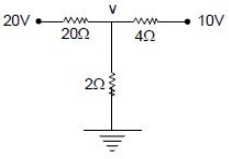

Download our appand get started for free
Experience the future of education. Simply download our apps or reach out to us for more information. Let's shape the future of learning together!No signup needed.*
Similar Questions
- 1$A$ current passes through a wire of nonuniform cross section. Which of the following quantities are independent of the cross-section?View Solution
- 2A wire of length ' $r$ ' and resistance $100 \Omega$ is divided into $10$ equal parts. The first $5$ parts are connected in series while the next $5$ parts are connected in parallel. The two combinations are again connected in series. The resistance of this final combination is:View Solution
- 3Refer to the circuit shown. What will be the total power dissipation in the circuit if $P$ is the power dissipated in $R_1$ ? It is given that $R_2=4 R_1$ and $R_3=12 R_1$ are .......... $P$View Solution
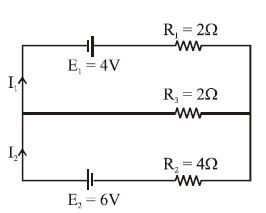
- 4In the circuit shown below $E_1\, =4.0\, V$, $R_1\, = 2\,\Omega$, $E_2\, = 6.0\, V$, $R_2\, = 4\,\Omega$ and $R_3\, = 2\,\Omega$. The current $I_1$ is ............... $\mathrm{A}$View Solution
- 5A metal wire of resistance $3\,\Omega $ is elongated to make a uniform wire of double its previous length. The new wire is now bent and the ends joined to make a circle. If two points on this circle make an angle $60^o$ at the centre, the equivalent resistance between these two points will beView Solution
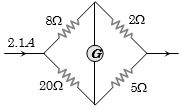
- 6In the given figure, when galvanometer shows no deflection, the current (in $A$) flowing through $5\,\Omega $ resistance will beView Solution
- 7Two bulbs of $500\, watt$ and $200\, watt$ are manufactured to operate on $220\, volt$ line. The ratio of heat produced in $500\, W$ and $200\, W$, in two cases, when firstly they are joined in parallel and secondly in series, will beView Solution
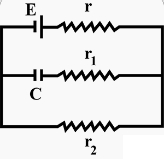
- 8In the given circuit diagram when the current reaches steady state in the circuit, the charge on the capacitor of capacitance $C$ will beView Solution
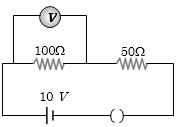
- 9In the given circuit, the voltmeter records $5\, volts$. The resistance of the voltmeter in $ohms$ isView Solution
- 10In order to quadruple the resistance of a uniform wire, a part of its length was uniformly stretched till the final length of the entire wire was $1.5$ times the original length, the part of the wire was fraction equal toView Solution