Question
The diagram below represents an experimental set up to demonstrate a vital process. Study the same and then answer the questions that follow:
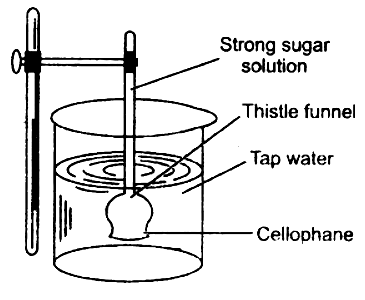

(i) Name the process.
(ii) Define the above named process.
(iii) What would you observe in the experimental setup after an hour or so?
(iv) What control experiment can be set up for the above experiment?
(v) Keeping in mind the root hair cell and its surrounding name the part that corresponds to (1) Concentrated sugar solution, (2) Parchment paper, (3) Water in the beaker.
(vi) Name any other substance that can be used instead of parchment paper in the above experiment.
(vii) Mention two advantages of this process to the plant.
Answer

(i) Osmosis.
(ii) Transfer of water or solvent molecules from a solution of lower concentration to a solution of higher concentration through a semi-permeable membrane is called osmosis.
(iii) The level of sugar solution rises in the stem of thistle funnel, whereas the water level in the beaker falls.
(iv) A non-permeable membrane can be used in place of parchment paper for a control experiment.
(v) (1) Root hair cell sap corresponds to concentrated sugar solution.
(2) Cell membrane of root hair cell corresponds to parchment paper.
(3) Soil solution corresponds to water in the beaker.
(vi) Goat’s bladder or pig’s bladder.
(vii) (1) Helps in water absorption.
(2) Helps in stomatal opening and closing thus facilitating gaseous exchange.

Need a full question paper?

Generate a complete, print-ready paper with questions like this in minutes — across 16+ boards, with answer keys.

Start Generating Free

Similar questions

Briefly mention the structure of a typical chromosome.
What is the difference between diffusion and osmosis? State the significance of osmosis in plant physiology.
Given alongside is a diagram of the external features of the heart.
(i) Name the parts$ ‘1’$ to $‘7’.$
(ii) What happens if the coronary artery gets an internal clot?
(iii) Which type of blood does part$ ‘5’ $carry?
(iv) Mention one structural difference between part ‘5’ and$ ‘4’.$
Given alongside is a diagram depicting a defect of the human eye. Study the same and then answer the questions that follow:
(i) Identify the defect.
(ii) Name the parts labelled 1, 2 and 3.
(iii) Give labelled two possible reasons for this eye defect.
(iv) Draw a labelled diagram to show how the above mentioned defect is rectified.
Draw a labelled diagram to show the metaphase stage of mitosis in an animal cell having ‘6’ chromosomes.
How would you justify that Australopithecus was a human ancestor?
Given below is a diagram representing a stage during mitotic cell division. Study it carefully and answer the question that follow.

How will you differentiate between mitosis and meiosis on the basis of the chromosome number in the daughter cells?
The diagram alongside represents a certain defect of vision of the human eye.
(i) Name the defect.
(ii) Describe briefly the condition in the eye responsible for the defect.
(iii) Redraw the figure by adding a suitable lens correcting the defect. Label the parts through which light-rays pass.
(iv) What special advantage do human beings derive in having both eyes facing forward?
What differences are there in number, structure, and activity of the male and female gametes in a man?
Complete the following table by filling in the blank spaces.
StructureFunction
Yellow Spot
Transfers impulse from inner ear to brain
Helps to change the focal length of the eye lens
Spinal cord
Oval window
Dynamic equilibrium