A wire can be broken by applying a load of $20\, kg$ weight. The force required to break the wire of twice the diameter is .......... $kg\, wt$
Medium


Download our appand get started for free
Experience the future of education. Simply download our apps or reach out to us for more information. Let's shape the future of learning together!No signup needed.*
Similar Questions
- 1$Assertion :$ Strain causes the stress in an elastic body.View Solution
$Reason :$ An elastic rubber is more plastic in nature. - 2View SolutionWhen strain is produced in a body within elastic limit, its internal energy
- 3The pressure of a medium is changed from $1.01 × 10^5$ $Pa$ to $1.165 × 10^5$ $Pa$ and change in volume is $10\% $ keeping temperature constant. The Bulk modulus of the medium isView Solution
- 4View SolutionFour uniform wires of the same material are stretched by the same force. The dimensions of wire are as given below. The one which has the minimum elongation has
- 5The force required to stretch a wire of crosssection $1 cm ^{2}$ to double its length will be ........ $ \times 10^{7}\,N$View Solution
(Given Yong's modulus of the wire $=2 \times 10^{11}\,N / m ^{2}$ )
- 6A steel wire having a radius of $2.0\, mm$, carrying a load of $4\, kg$, is hanging from a ceiling. Given that $g = 3.1\pi \,m{s^{ - 2}}$ , what will be the tensile stress that would be developed in the wire?View Solution
- 7The length of an elastic string is a metre when the longitudinal tension is $4\, N$ and $b$ metre when the longitudinal tension is $5\, N$. The length of the string in metre when the longitudinal tension is $9\, N$ isView Solution
- 8A wire is stretched by $0.01$ $m$ by a certain force $F.$ Another wire of same material whose diameter and length are double to the original wire is stretched by the same force. Then its elongation will beView Solution
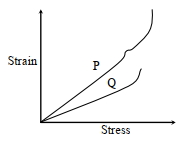
- 9In plotting stress versus strain curves for two materials $P$ and $Q$, a student by mistake puts strain on the $y$-axis and stress on the $x$-axis as shown in the figure. Then the correct statement$(s)$ is(are)View Solution
$(A)$ $P$ has more tensile strength than $Q$
$(B)$ $P$ is more ductile than $Q$
$(C)$ $P$ is more brittle than $Q$
$(D)$ The Young's modulus of $P$ is more than that of $Q$
- 10A brass rod of length $2\,m$ and cross-sectional area $2.0\,cm^2$ is attached end to end to a steel rod of length $L$ and cross-sectional area $1.0\,cm^2$ . The compound rod is subjected to equal and opposite pulls of magnitude $5 \times 10^4\,N$ at its ends. If the elongations of the two rods are equal, then length of the steel rod $(L)$ is ........... $m$ $(Y_{Brass}=1.0\times 10^{11}\,N/m^2$ and $Y_{Steel} = 2.0 \times 10^{11}\,N/m^2)$View Solution