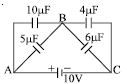
In the circuit shown in figure, four capacitors are connected to a battery. The charge on the $5$ $\mu$$F$ capacitor is.......$ \mu C$
Medium
Download our app for free and get started

Download our appand get started for free
Experience the future of education. Simply download our apps or reach out to us for more information. Let's shape the future of learning together!No signup needed.*
Similar Questions
- 1To form a composite $16\,\mu F,\;1000\,V$ capacitor from a supply of identical capacitors marked $8\,\mu F,\;250\,V$, we require a minimum number of capacitorsView Solution
- 2The radius of nucleus of silver (atomic number $=$ $47$) is $3.4 \times {10^{ - 14}}\,m$. The electric potential on the surface of nucleus is $(e = 1.6 \times {10^{ - 19}}\,C)$View Solution
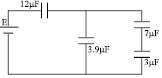
- 3Four capacitors and a battery are connected as shown. The potential drop across the $7$ $ \mu F$ capacitor is $ 6$ $ V$. Then the :View Solution
- 4If an $\alpha$-particle and a proton are accelerated from rest by a potential difference of 1 megavolt then the ratio of their kinetic energy will beView Solution
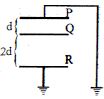
- 5See the diagram . Area of each plate is $2.0\ m^2$ and $d = 2 \times 10^{-3}\ m$. A charge of $8.85 \times 10^{-8}\ C$ is given to $Q$. Then the potential of $Q$ becomes......$V$View Solution
- 6Two insulating plates are both uniformly charged in such a way that the potential difference between them is $V_2 - V_1 = 20\ V$. (i.e., plate $2$ is at a higher potential). The plates are separated by $d = 0.1\ m$ and can be treated as infinitely large. An electron is released from rest on the inner surface of plate $1. $ What is its speed when it hits plate $2?$View Solution
$(e = 1.6 \times 10^{-19}\ C, m_e= 9.11 \times 10^{-31}\ kg)$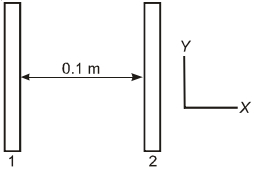
- 7View SolutionThe combined capacity of the parallel combination of two capacitors is four times their combined capacity when connected in series. This means that
- 8Two capacitances of capacity ${C_1}$ and ${C_2}$ are connected in series and potential difference $V$ is applied across it. Then the potential difference across ${C_1}$ will beView Solution
- 9Assertion : A parallel plate capacitor is connected across battery through a key. A dielectric slab of dielectric constant $K$ is introduced between the plates. The energy which is stored becomes $K$ times.View Solution
Reason : The surface density of charge onthe plate remains constant or unchanged.
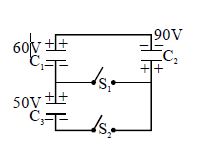
- 10Three charged capacitors, $C_1$ = $17\ μF$, $C_2$ = $34\ μF$, $C_3$ = $41\ μF$and two open switches, $S_1$ and $S_2$ are assembled into a network with initial voltages and polarities, as shown. Final status of the network is attained when the two switches, $S_1$ and $S_2$ are closed. In the figure, the final charge on capacitor $C_3$ in $mC$, is closet to:View Solution