The diameter of two pistons of a hydraulic press are $0.1\,\, m$ and $0.6\,\, m$ respectively. Advantage of the hydraulic press assuming effort is applied directly on pump plunger
Medium
Download our app for free and get started
$Mech.$ $adv.$ $(MA)$
$=\frac{\text { Area of bigger piston }}{\text { Area of smaller piston }}$
$=\frac{\pi\left(\frac{\mathrm{d}_{1}}{2}\right)^{2}}{\pi\left(\frac{\mathrm{d}_{2}}{2}\right)^{2}}=\frac{\mathrm{d}_{1}^{2}}{\mathrm{d}_{2}^{2}}=\frac{0.36}{0.01}=36$

Download our appand get started for free
Experience the future of education. Simply download our apps or reach out to us for more information. Let's shape the future of learning together!No signup needed.*
Similar Questions
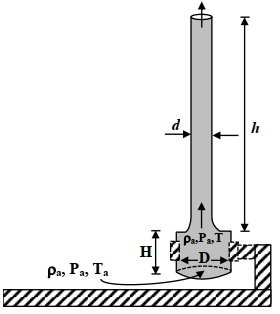
- 1A cylindrical furnace has height $(H)$ and diameter $(D)$ both $1 \mathrm{~m}$. It is maintained at temperature $360 \mathrm{~K}$. The air gets heated inside the furnace at constant pressure $P_a$ and its temperature becomes $T=360 \mathrm{~K}$. The hot air with density $\rho$ rises up a vertical chimney of diameter $d=0.1 \mathrm{~m}$ and height $h=9 \mathrm{~m}$ above the furnace and exits the chimney (see the figure). As a result, atmospheric air of density $\rho_a=1.2 \mathrm{~kg} \mathrm{~m}^{-3}$, pressure $P_a$ and temperature $T_a=300 \mathrm{~K}$ enters the furnace. Assume air as an ideal gas, neglect the variations in $\rho$ and $T$ inside the chimney and the furnace. Also ignore the viscous effects.View Solution
[Given: The acceleration due to gravity $g=10 \mathrm{~ms}^{-2}$ and $\pi=3.14$ ]
(image)
($1$) Considering the air flow to be streamline, the steady mass flow rate of air exiting the chimney is
. . . . .$\mathrm{gm} \mathrm{s}^{-1}$.
($2$) When the chimney is closed using a cap at the top, a pressure difference $\Delta P$ develops between the top and the bottom surfaces of the cap. If the changes in the temperature and density of the hot air, due to the stoppage of air flow, are negligible then the value of $\Delta P$ is. . . . .$\mathrm{Nm}^{-2}$.
- 2View SolutionA boy carries a fish in one hand and a bucket(not full) of water in the other hand . If he places the fish in the bucket , the weight now carried by him (assume that water does not spill) :
- 3If a ball of steel (density $\rho=7.8 \;gcm ^{-3}$) attains a terminal velocity of $10 \;cms ^{-1}$ when falling in a tank of water (coefficient of viscosity $\eta_{\text {water }}=8.5 \times 10^{-4} \;Pa - s$ ) then its terminal velocity in glycerine $\left(\rho=12 gcm ^{-3}, \eta=13.2\right)$ would be nearlyView Solution
- 4A horizontal pipe line carries water in a streamline flow.At a point along the tube where the cross-sectional area is $10^{-2}$ $m^2$, the water velocity is $2$ $ms^{^{-1}}$ and the pressure is $8000 $ $Pa$. The pressure of water at another point where the cross-sectional area is $0.5$ $\times 10^{-2}$ $m^2$ is ........ $Pa$View Solution
- 5The velocity of water in a river is $18\, km/h$ near the surface. If the river is $5\, m$ deep, find the shearing stress between the horizontal layers of water. The co-efficient of viscosity of water $= 10^{-2}\,,poise$View Solution
- 6View SolutionThe property of a liquid by which it opposes the flow of itself is called ..........
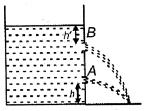
- 7A tank is filled with water and two holes $A$ and $B$ are made in it. For getting same range, ratio of $h^{\prime} T h$ is ..........View Solution
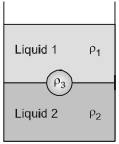
- 8A jar is filled with two non-mixing liquids $1$ and $2$ having densities $\rho_1$ and, $\rho_2$ respectively. A solid ball, made of a material of density $\rho_3$ , is dropped in the jar. It comes to equilibrium in the position shown in the figure.Which of the following is true for $\rho_1 , \rho_2$ and $\rho_3$?View Solution
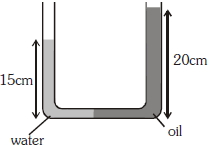
- 9In a $U-$tube as shown in figure, water and oil are in the left side and right side of the tube respectively. The helghts from the bottom for water and oil columns are $15\; \mathrm{cm}$ and $20\; \mathrm{cm}$ respectively. The density of the oil is......$kg/{m}^{3}$View Solution
[take $\rho_{water} \left.=1000 \;\mathrm{kg} / \mathrm{m}^{3}\right]$
- 10A tank of height $5\, m$ is full of water. There is a hole of cross sectional area $1\, cm^2$ in its bottom. The initial volume of water that will come out from this hole per second isView Solution