The direction of magnetic force on the electron as shown in the diagram is along
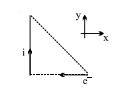
Easy


Download our appand get started for free
Experience the future of education. Simply download our apps or reach out to us for more information. Let's shape the future of learning together!No signup needed.*
Similar Questions
- 1A beam of protons with speed $4 \times 10^{5}\, ms ^{-1}$ enters a uniform magnetic field of $0.3\, T$ at an angle of $60^{\circ}$ to the magnetic field. The pitch of the resulting helical path of protons is close to....$cm$View Solution
(Mass of the proton $=1.67 \times 10^{-27}\, kg$, charge of the proton $=1.69 \times 10^{-19}\,C$)
- 2When a $12\,\Omega $ resistor is connected with a moving coil galvanometer then its deflection reduces from $50$ divisions to $10$ divisions. The resistance of the galvanometer is ............. $\Omega $View Solution
- 3The resistance of a galvanometer is $50\, ohm$ and the maximum current which can be passed through it is $0.002\, A$. What resistance must be connected to it in order to convert it into an ammeter of range $0 -0.5\, A$ ?....$ohm$View Solution
- 4View SolutionTwo parallel beams of electrons moving in the same direction produce a mutual force
- 5An electron moves with a constant speed $v$ along a circle of radius $r$. Its magnetic moment will be ($e$ is the electron's charge)]View Solution
- 6An insulating thin rod of length $l$ has a linear charge density $\rho \left( x \right) = {\rho _0}\,\frac{x}{l}$ on it. The rod is rotated about an axis passing through the origin $(x = 0)$ and perpendicular to the rod. If the rod makes $n$ rotations per second, then the time averaged magnetic moment of the rod isView Solution
- 7A proton (mass $ = 1.67 \times {10^{ - 27}}\,kg$ and charge $ = 1.6 \times {10^{ - 19}}\,C)$ enters perpendicular to a magnetic field of intensity $2$ $weber/{m^2}$ with a velocity $3.4 \times {10^7}\,m/\sec $. The acceleration of the proton should beView Solution
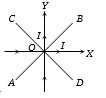
- 8Two very thin metallic wires placed along $X$ and $Y$-axis carry equal currents as shown here. $AB$ and $CD$ are lines at $45^\circ $ with the axes with origin of axes at $O$. The magnetic field will be zero on the lineView Solution
- 9A galvanometer gives full scale deflection with $0.006$ A current. By connecting it to a $4990 \ \Omega$ resistance, it can be converted into a voltmeter of range $0-30 \ V$. If connected to a $\frac{2 n }{249} \Omega$ resistance, it becomes an ammeter of range $0-1.5 \ A$. The value of $n$ is:View Solution
- 10A coil having $N$ turns is wound tightly in the form of a spiral with inner and outer radii $a$ and $b$ respectively. When a current $i$ passes through the coil, the magnetic field at the centre isView Solution