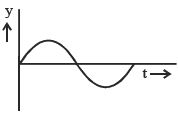
The displacement versus time graph of $SHM$ is Which of the following is its acceleration versus time graph ?
Easy
Download our app for free and get started

Download our appand get started for free
Experience the future of education. Simply download our apps or reach out to us for more information. Let's shape the future of learning together!No signup needed.*
Similar Questions
- 1The displacement of a particle executing $SHM$ is given by $y=0.25 \sin 200 t$ $cm$. The maximum speed of the particle is $.........cm s^{-1}$View Solution
- 2A clock $S$ is based on oscillations of a spring and a clock $P$ is based on pendulum motion. Both clocks run at the same rate on earth. On a planet having same density as earth but twice the radius thenView Solution
- 3Two particles execute $SHM$ of same amplitude of $20\, cm$ with same period along the same line about the same equilibrium position. The maximum distance between the two is $20\, cm.$ Their phase difference in radians isView Solution
- 4The acceleration of a particle performing S.H.M. is at a distance of $3\; cm$ from the mean position is $ 12\,cm/sec^2 $. Its time period is ..... $\sec$View Solution
- 5View SolutionWhich of the following is a necessary and sufficient condition for S.H.M.
- 6The potential energy of a simple harmonic oscillator of mass $2\, kg$ in its mean position is $5\, J.$ If its total energy is $9\,J$ and its amplitude is $0.01\, m,$ its time period would beView Solution
- 7A mass m performs oscillations of period $T$ when hanged by spring of force constant $K$. If spring is cut in two parts and arranged in parallel and same mass is oscillated by them, then the new time period will beView Solution
- 8A particle performs simple harmonic motion with amplitude $A$. Its speed is trebled at the instant that it is at a distance $\frac{{2A}}{3}$ from equilibrium position. The new amplitude of the motion isView Solution
- 9A mass m is suspended from a spring of length l and force constant $K$. The frequency of vibration of the mass is ${f_1}$. The spring is cut into two equal parts and the same mass is suspended from one of the parts. The new frequency of vibration of mass is ${f_2}$. Which of the following relations between the frequencies is correctView Solution
- 10A simple pendulum executing $S.H.M.$ is falling freely along with the support. ThenView Solution