The potential energy of a simple harmonic oscillator of mass $2\, kg$ in its mean position is $5\, J.$ If its total energy is $9\,J$ and its amplitude is $0.01\, m,$ its time period would be
Diffcult


Download our appand get started for free
Experience the future of education. Simply download our apps or reach out to us for more information. Let's shape the future of learning together!No signup needed.*
Similar Questions
- 1A particle moving along the $X-$axis executes simple harmonic motion, then the force acting on it is given byView Solution
Where $A$ and $K$ are positive constants
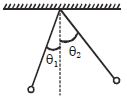
- 2Two masses, both equal to $100\, g$, are suspended at the ends of identical light strings of length $\lambda = 1.0\, m$, attached to the same point on the ceiling (see figure). At time $t = 0$, they are simultaneously released from rest, one at angle $\theta_1 = 1^o$, the other at angle $\theta_2 = 2^o$ from the vertical. The masses will collideView Solution
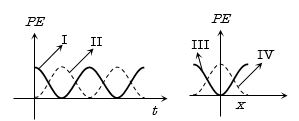
- 3For a particle executing $S.H.M.$ the displacement $x$ is given by $x = A\cos \omega t$. Identify the graph which represents the variation of potential energy $(P.E.)$ as a function of time $t$ and displacement $x$View Solution
- 4Force constant of a spring is $K$ . If half part is detached then force constant of the remaining spring will beView Solution
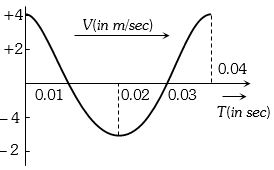
- 5The velocity-time diagram of a harmonic oscillator is shown in the adjoining figure. The frequency of oscillation is ..... $Hz$View Solution
- 6The potential energy of a particle executing S.H.M. is $ 2.5\, J$, when its displacement is half of amplitude. The total energy of the particle be .... $J$View Solution
- 7A particle of mass $m$ undergoes oscillations about $x=0$ in a potential given by $V(x)-\frac{1}{2} k x^2-V_0 \cos \left(\frac{x}{a}\right)$, where $V_0, k, a$ are constants. If the amplitude of oscillation is much smaller than $a$, the time period is given byView Solution
- 8The equation of $S.H.M.$ is $y = a\sin (2\pi nt + \alpha )$, then its phase at time $t$ isView Solution
- 9The motion of a particle varies with time according to the relation $y = a(\sin \omega \,t + \cos \omega \,t)$, thenView Solution
- 10A weightless spring which has a force constant oscillates with frequency $n$ when a mass $m$ is suspended from it. The spring is cut into two equal halves and a mass $2m $ is suspended from it. The frequency of oscillation will now becomeView Solution