Question
The distance between the plates of a parallel plate condenser is 4mm and potential difference is 60 volts. If the distance between the plates is increased to 12mm, then(a) The potential difference of the condenser will become 180 volts(b) The P.D. will become 20 volts(c) The P.D. will remain unchanged(d) The charge on condenser will reduce to one third


Answer

(a) The potential difference of the condenser will become 180 volts

Need a full question paper?

Generate a complete, print-ready paper with questions like this in minutes — across 16+ boards, with answer keys.

Start Generating Free

Similar questions

A moving coil type of galvanometer is based upon the principle that:
A diver at a depth of $12m$ in water $(\mu = \frac{4}{3})$ sees the sky in a cone of semi$-$vertical angle
If $P$ and $Q$ are two batteries connected in series with anode of one connected to anode of the other, producing voltages $E_1$ and $E_2>E_1$ respectively. The e.m.f of the pair is
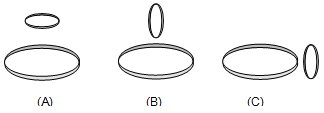
Two circular coils can be arranged in any of the three situations shown in the figure. Their mutual inductance will be
In a circuit with a coil of resistance 2 ohms, the magnetic flux changes from 2.0 Wb to 10.0 Wb in 0.2 second. The charge that flows in the coil during this time is(a) 5.0 coulomb(b) 4.0 coulomb(c) 1.0 coulomb(d) 0.8 coulomb
       
Product of resistivity and conductivity of any conductor depends on:
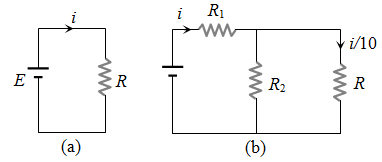
Consider the circuits shown in the figure. Both the circuits are taking same current from battery but current through $R$ in the second circuit is $\frac{1}{10}^{th}$ of current through $R$ in the first circuit. If $R$ is $11 \Omega$, the value of $R_1$
An ideal coil of $10$ henry is joined in series with a resistance of $5$ ohm and a battery of $5$ volt.  $2$ second after joining, the current flowing in ampere in the circuit will be
Charge on an $\alpha - \text{particle}$ is:
When a current passes through the junction of two different  metals, evolution or absorption of heat at the junction is known as(a) Joule  effect(b) Seebeck effect(c) Peltier effect(d) Thomson effect